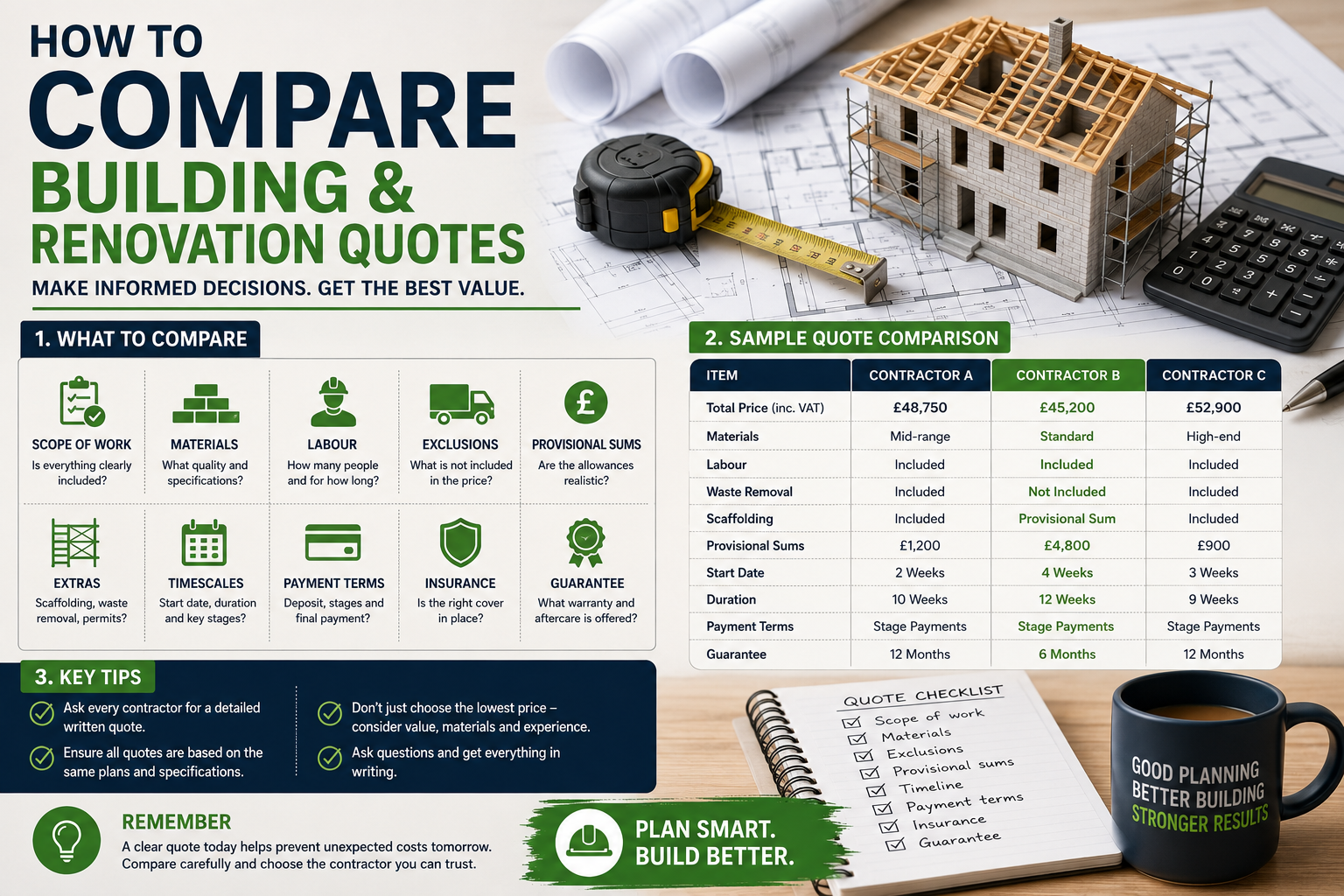
How to Compare Quotes for Building and Renovation Work
Comparing quotations for building or renovation work is not always as simple as choosing the lowest price.
Two contractors may provide very different figures for what appears to be the same project. One quotation may include materials, waste removal and specialist trades, while another may leave several important costs out.
A lower figure can sometimes represent good value. In other cases, it may reflect a reduced scope, cheaper materials, unrealistic allowances or missing work that will be charged separately later.
The most reliable way to compare quotations is to examine what each contractor has included, what has been excluded and how clearly the project has been defined.
Make Sure Each Contractor Is Pricing the Same Work
Contractors can only provide genuinely comparable quotations when they are working from the same information.
Before requesting prices, prepare a clear project brief.
Depending on the work, this may include:
- Drawings
- Measurements
- Specifications
- Planning documents
- Structural calculations
- A schedule of finishes
- Product preferences
- Photographs
- Access information
- Expected completion standards
For a simple project, a detailed written description may be sufficient.
For larger renovations, extensions or structural work, professional plans and specifications can reduce ambiguity.
Without a consistent brief, each contractor may make different assumptions. The resulting prices may appear comparable when they actually cover different versions of the project.
Understand the Difference Between a Quote and an Estimate
The terms “quotation” and “estimate” are sometimes used interchangeably, but they do not always mean the same thing.
A quotation
A quotation is usually a more definite price for a clearly described scope of work.
It may still change if:
- The homeowner requests additional work
- Hidden defects are discovered
- The specification changes
- Material prices change under an agreed clause
- Provisional sums are exceeded
An estimate
An estimate is an informed prediction of what the work may cost.
The final price may be higher or lower depending on what happens during the project.
Homeowners should ask the contractor to explain whether the figure is:
- Fixed
- Estimated
- Budgetary
- Based on provisional allowances
- Subject to measurement
- Subject to material-price changes
This should be confirmed in writing.
Compare the Scope of Work
The scope of work describes what the contractor has agreed to complete.
It should be detailed enough to show:
- Which rooms or areas are included
- What will be removed
- What will be built or installed
- Which surfaces will be finished
- Which services will be altered
- Who will supply materials
- Who will arrange inspections
- What condition the property will be left in
A quote stating “complete kitchen renovation” may sound comprehensive, but it leaves many questions unanswered.
A clearer scope might specify:
- Removal of existing units
- Disposal of waste
- Electrical alterations
- Plumbing changes
- Wall preparation
- Installation of units
- Worktop fitting
- Tiling
- Decoration
- Final cleaning
The more precise the scope, the easier it is to compare quotations and manage expectations.
Check the Materials Included
Material quality can significantly affect the price.
Ask each contractor to identify:
- Product brands
- Model numbers
- Quantities
- Material grades
- Dimensions
- Finishes
- Warranty periods
- Supply allowances
A quotation may refer to “standard fittings” or “quality materials” without defining what these terms mean.
This can result in disagreements when the homeowner expects one product and the contractor has priced another.
Where final products have not yet been selected, the quotation may include an allowance.
For example:
- £35 per square metre for tiles
- £500 for bathroom fittings
- £2,000 for kitchen appliances
Check whether these allowances are realistic for the standard you expect.
If the actual products cost more, the difference will usually be added to the final price.
Review Labour Costs
Some quotations show labour separately, while others include it within each stage of work.
Either approach can be acceptable, provided the scope is clear.
Ask whether labour includes:
- Site preparation
- Demolition
- Installation
- Specialist trades
- Supervision
- Project management
- Cleaning
- Return visits
- Final adjustments
A contractor with a lower labour figure may have allowed fewer working days, fewer people or less specialist input.
It is also worth asking whether the contractor charges:
- A fixed project rate
- A daily rate
- An hourly rate
- A management fee
- A percentage on subcontractor work
For work charged by time, ask how hours or days will be recorded and approved.
Look Closely at Provisional Sums
A provisional sum is an allowance for work or materials that cannot yet be priced accurately.
These are common where:
- Hidden conditions may be discovered
- The homeowner has not chosen finishes
- Specialist work has not been fully designed
- Ground conditions are unknown
- Existing services need investigation
Provisional sums are not necessarily a problem.
However, a quote containing many low provisional allowances can appear cheaper than it is likely to be.
For each provisional sum, ask:
- What does it cover?
- How was the allowance calculated?
- Is it considered realistic?
- What happens if the cost is higher?
- Will any unused amount be deducted?
- Does the contractor add a margin?
A quotation with a higher total but fewer uncertainties may ultimately provide better cost control.
Check Whether VAT Is Included
Always confirm whether VAT is included in the quoted price.
A figure excluding VAT can appear significantly lower than one that includes it.
The quotation should state clearly:
- Whether the contractor is VAT registered
- Whether VAT applies
- The rate charged
- Whether the total includes VAT
Do not assume.
A quote of £20,000 excluding VAT represents a different cost from a quote of £20,000 including VAT.
Review Waste Removal and Site Clearance
Waste disposal can become a significant project cost.
Check whether the quotation includes:
- Skips
- Waste collection
- Disposal fees
- Recycling
- Removal of demolition materials
- Packaging
- Final site clearance
Also ask:
- Who will arrange permits for skips?
- Where will waste be stored?
- Is hazardous waste handled separately?
- Is final cleaning included?
A contractor may quote only for the building work and expect the homeowner to arrange waste removal.
This should be identified before the project starts.
Check Scaffolding, Access and Equipment
Some projects require specialist equipment or temporary access arrangements.
Possible costs include:
- Scaffolding
- Towers
- Lifting equipment
- Temporary fencing
- Site toilets
- Protective coverings
- Parking permits
- Road closures
- Storage
- Security
Check whether these are included.
For work at height, external renovation or roofing, scaffolding can represent a substantial expense.
A quotation that excludes it may not be directly comparable with one that includes it.
Examine Specialist Trade Costs
Building and renovation projects often involve several trades.
These may include:
- Electricians
- Plumbers
- Heating engineers
- Roofers
- Plasterers
- Carpenters
- Tilers
- Decorators
- Structural specialists
Ask whether these services are:
- Included in the main quotation
- Priced as allowances
- Charged separately
- Arranged by the homeowner
- Managed by the main contractor
It is usually easier when responsibility is clearly assigned.
If the homeowner is expected to organise certain trades, the project programme should account for this.
Check Professional and Statutory Fees
The contractor’s price may not include professional or regulatory costs.
Possible additional expenses include:
- Architect fees
- Structural-engineer fees
- Planning application fees
- Building-control fees
- Surveyor fees
- Party wall services
- Drainage surveys
- Specialist reports
- Warranty fees
Ask which of these are included and which must be arranged separately.
Homeowners should build these costs into the overall project budget rather than comparing only construction prices.
Review Decoration and Final Finishes
Quotations often differ in how they treat decoration and finishing work.
Check whether the price includes:
- Plaster preparation
- Priming
- Painting
- Woodwork
- Sealants
- Flooring
- Tiling
- Grouting
- Trims
- Final touch-ups
Terms such as “ready for decoration” should be clarified.
Does this mean the surface is fully prepared and only requires paint, or will additional filling, sanding or priming be necessary?
Small differences in finishing standards can create substantial differences in cost.
Compare Timescales
The cheapest quotation may not be the most practical if it involves a much longer programme.
Ask each contractor for:
- Proposed start date
- Expected duration
- Key project stages
- Working days
- Likely interruptions
- Material lead times
- Inspection points
- Completion date
Also ask how many projects the contractor will manage at the same time.
A quotation based on continuous attendance may be more valuable than one where the contractor works intermittently over a longer period.
However, unusually short timelines should also be questioned.
Some work requires appropriate drying, curing, inspection and preparation time.
Examine the Payment Schedule
The payment structure should be proportionate to the progress of the work.
Typical arrangements may include:
- A deposit
- Payment for ordered materials
- Stage payments
- Payments following inspections
- A final payment
- Retention for outstanding items
Compare:
- How much is required upfront
- When each payment is due
- What milestone triggers payment
- Whether invoices will be provided
- How additional work is charged
- Whether final payment is due before defects are resolved
Avoid comparing only the total price.
A contractor requesting a very large upfront payment may create greater financial risk.
Understand How Variations Will Be Handled
Variations are changes to the original scope.
They may be requested by the homeowner or required because of unexpected conditions.
The quotation or contract should explain:
- How changes are requested
- Who can approve them
- How they are priced
- Whether a contractor margin applies
- How they affect the timeline
- Whether written approval is required
Without a clear variation process, costs can increase through a series of informal decisions.
Every variation should ideally include:
- A description
- The additional or reduced cost
- The effect on completion
- Written agreement
Check Guarantees and Warranties
Compare the aftercare offered by each contractor.
Ask about:
- Workmanship guarantees
- Manufacturer warranties
- Structural warranties
- Installation certificates
- Defect-resolution procedures
- Response times
- Exclusions
A longer guarantee is not automatically better if the terms are unclear or the contractor is difficult to contact.
The quotation should explain what documentation will be provided at completion.
Consider the Quality of Communication
The quotation itself can reveal how the contractor communicates.
Look for:
- Clear descriptions
- Consistent figures
- Prompt responses
- Willingness to answer questions
- Professional presentation
- Transparent assumptions
- Specific exclusions
A contractor who provides a clear and thoughtful quotation may be easier to work with than one who sends only a brief total.
However, presentation alone should not determine the decision.
The content remains more important than the appearance.
Check References and Previous Work
Price should be considered alongside evidence of reliability and workmanship.
Ask for recent references involving similar projects.
Useful questions for previous customers include:
- Was the quotation accurate?
- Were additional costs explained?
- Did the project start and finish as expected?
- Was communication reliable?
- Was the property kept reasonably organised?
- Were problems resolved?
- Would you use the contractor again?
Photographs and case studies can also help, but they should not replace direct checks where the project is substantial.
Do Not Assume the Lowest Price Is the Best Value
A low quotation may be genuine, particularly when the contractor has lower overheads or a simpler operating structure.
However, it may also reflect:
- Missing work
- Unrealistic allowances
- Lower-quality materials
- Limited insurance
- Reduced supervision
- Inexperienced labour
- An error in pricing
- A plan to charge for extras later
Ask the contractor to explain significant differences.
A professional contractor should be able to describe how the price was prepared.
Do Not Assume the Highest Price Is the Best Either
A high price does not automatically guarantee superior quality.
The quotation may include:
- Higher overheads
- Larger management costs
- Premium materials
- Greater contingency
- Additional services
- A higher profit margin
These may be justified, but they should be understood.
The decision should be based on scope, quality, confidence and value rather than price alone.
Create a Simple Comparison Table
A comparison table can make differences easier to see.
Include rows for:
| Item | Contractor A | Contractor B | Contractor C |
|---|---|---|---|
| Total price | |||
| VAT included | |||
| Start date | |||
| Duration | |||
| Materials | |||
| Waste removal | |||
| Scaffolding | |||
| Electrical work | |||
| Plumbing work | |||
| Decoration | |||
| Provisional sums | |||
| Payment terms | |||
| Guarantee | |||
| Insurance checked | |||
| References checked |
This can reveal where a lower quote is missing important items.
Ask for Clarification Before Accepting
Do not be afraid to ask questions.
A quotation is not clear simply because it is several pages long.
Useful questions include:
- Is this item included?
- Which product has been allowed for?
- Is VAT included?
- Who arranges the inspection?
- What happens if this allowance is exceeded?
- Does this include decoration?
- How will additional work be approved?
- What completion documents will be supplied?
Responses should be added to the quotation or contract where they affect the agreement.
Allow for Contingency
Even a detailed quotation cannot eliminate every uncertainty.
Older properties may reveal:
- Damp
- Damaged timber
- Unsafe wiring
- Plumbing problems
- Structural movement
- Asbestos-containing materials
- Inadequate foundations
- Hidden leaks
A contingency fund can help cover genuine unforeseen costs.
The appropriate amount depends on:
- Property age
- Project complexity
- Quality of surveys
- Accessibility
- Amount of demolition
- Certainty of the design
A contingency is not a substitute for proper planning, but it can reduce financial pressure when unexpected work arises.
Confirm the Final Agreement in Writing
Once a contractor has been selected, the final agreement should include:
- Approved quotation
- Drawings
- Specifications
- Scope
- Exclusions
- Price
- Payment schedule
- Timeline
- Responsibilities
- Variation procedure
- Insurance
- Guarantees
- Dispute process
Any important clarification made during the comparison process should be incorporated into the contract.
Do not rely on verbal promises.
Final Thoughts
The best quotation is not necessarily the lowest or the highest.
It is the one that gives a clear, realistic and properly defined price for the work required.
Homeowners should compare scope, materials, exclusions, allowances, labour, payment terms, timescales and aftercare before making a decision.
A detailed comparison takes more time at the beginning, but it can reduce the risk of unexpected costs and disputes later.
For major or technically complex projects, independent advice from an architect, surveyor, quantity surveyor or another suitably qualified professional may help homeowners assess quotations more confidently.