Which Home Improvements Can Add Practical Value to a Property?
Home improvements can make a property more comfortable, functional and suitable for the people living in it.
Some projects may also make a home more appealing to future buyers, but financial returns are never guaranteed. The value of an improvement depends on factors such as location, property type, build quality, local demand and the amount spent.
A project that works well for one home may be unnecessary or unsuitable for another.
The most useful improvements usually solve a genuine problem, make better use of available space or reduce ongoing maintenance.
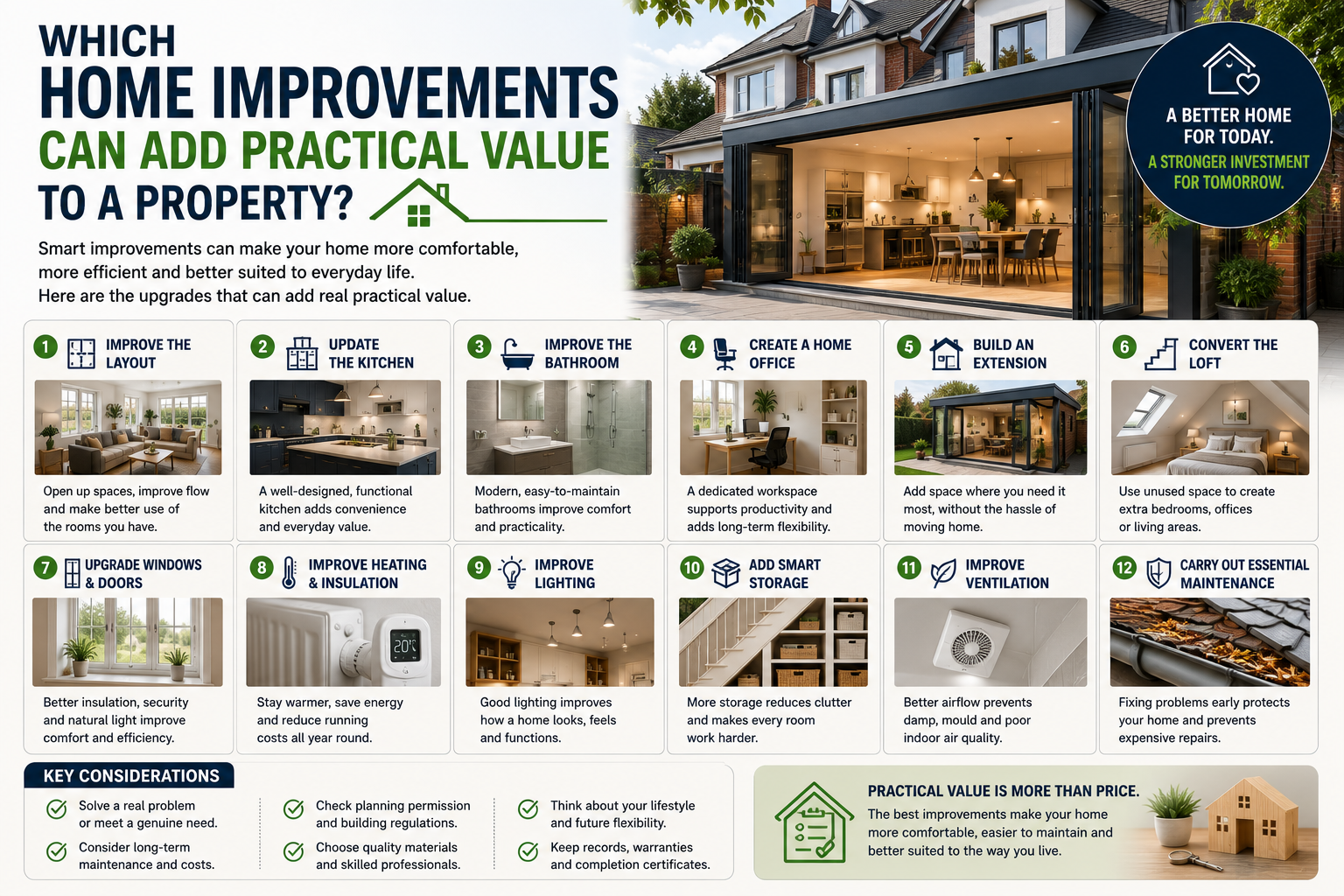
Here are several home improvements that can add practical value to a property.
1. Improving the Layout
A better layout can make an existing home feel larger and easier to use without necessarily increasing its floor area.
Possible changes include:
- Opening up a small kitchen and dining area
- Creating a separate utility space
- Improving access between rooms
- Repositioning internal doors
- Adding built-in storage
- Separating work and living areas
- Improving natural light
- Removing an impractical corridor
Layout changes should be planned carefully.
Removing walls can affect structure, fire safety, heating, acoustics and privacy. Some walls may also contain plumbing, electrical wiring or other services.
A layout should support how people actually use the home rather than follow a design trend that may not suit the property.
2. Adding Useful Storage
Storage is one of the most practical improvements a homeowner can make.
Poorly organised storage can make a spacious home feel cluttered, while well-designed storage can improve everyday use.
Options may include:
- Built-in wardrobes
- Under-stair cupboards
- Window-seat storage
- Hallway storage
- Pantry cupboards
- Utility-room units
- Garage shelving
- Loft storage
- Bespoke alcove units
Good storage should be accessible and appropriately sized.
It is often more useful to create storage for specific items than to add cupboards without considering what they need to hold.
3. Updating the Kitchen
The kitchen is often one of the most heavily used areas of a home.
A full replacement may not always be necessary. Practical improvements can include:
- Replacing damaged worktops
- Improving lighting
- Updating cabinet doors
- Adding more storage
- Improving ventilation
- Replacing inefficient appliances
- Installing durable flooring
- Creating better preparation space
- Improving electrical provision
A new kitchen should be planned around workflow, storage and maintenance rather than appearance alone.
Homeowners should consider:
- How many people use the kitchen
- Whether more sockets are needed
- How waste and recycling are stored
- Whether appliances are easy to access
- How surfaces will be cleaned
- Whether the layout allows safe movement
Expensive finishes do not automatically create a better kitchen.
4. Improving the Bathroom
Bathroom improvements can make a home more comfortable and easier to maintain.
Useful changes may include:
- Better ventilation
- Improved lighting
- More storage
- A reliable shower
- Easier-to-clean surfaces
- Updated plumbing
- Non-slip flooring
- Improved water pressure
- Accessible fittings
A bathroom refurbishment should address underlying problems such as leaks, mould, poor extraction or damaged flooring before decorative work begins.
Waterproofing and ventilation are particularly important.
A visually attractive bathroom can quickly deteriorate if moisture is not managed properly.
5. Creating a Home Office
Working from home has increased the value of having a dedicated workspace for many households.
A useful home office does not always require a separate room.
Possible options include:
- Converting a spare bedroom
- Using part of a larger room
- Creating a garden office
- Adding built-in desk space
- Improving a loft room
- Adapting an underused dining room
A practical workspace should consider:
- Natural light
- Electrical sockets
- Internet access
- Heating
- Ventilation
- Noise
- Storage
- Background privacy for calls
A home office should remain flexible where possible.
A room that can also function as a bedroom, study or hobby space may be more useful over the long term.
6. Building an Extension
An extension can provide additional living space without moving to a larger property.
Common uses include:
- Larger kitchens
- Dining areas
- Family rooms
- Utility rooms
- Additional bedrooms
- Home offices
- Accessible ground-floor accommodation
Before planning an extension, homeowners should consider:
- How much garden space will remain
- Whether the layout will improve
- Access for construction
- Planning requirements
- Building regulations
- Party wall matters
- Drainage
- Natural light
- Construction cost
- Disruption
An extension should feel connected to the existing home.
Adding floor area without improving the overall layout may create an expensive space that is awkward to use.
7. Converting a Loft
A loft conversion may provide an additional bedroom, office or living area.
Suitability depends on:
- Roof height
- Roof structure
- Staircase position
- Floor strength
- Fire safety
- Natural light
- Planning constraints
- Insulation
- Access
- Available budget
Not every loft can be converted economically.
The staircase can take up more space than expected, and structural alterations may be substantial.
A professional assessment can help determine whether the project is practical.
8. Converting a Garage
An attached or integral garage may be converted into usable internal space.
Possible uses include:
- Office
- Playroom
- Bedroom
- Utility room
- Accessible living space
- Small studio
Before converting a garage, consider whether losing parking or storage will create a new problem.
Other factors include:
- Floor levels
- Damp protection
- Insulation
- Heating
- Windows
- Ventilation
- Fire separation
- Planning requirements
A garage conversion can be useful when the space is underused, but it should be designed to feel like part of the house rather than a temporary adaptation.
9. Improving Insulation
Better insulation can improve comfort and reduce unnecessary heat loss.
Potential improvements include:
- Loft insulation
- Cavity-wall insulation
- Internal wall insulation
- External wall insulation
- Floor insulation
- Pipe insulation
- Draught reduction
- Improved roof insulation
The most appropriate option depends on the construction of the property.
Older buildings may require a different approach from modern homes. Materials should be compatible with the building to avoid trapping moisture or causing ventilation problems.
Professional advice may be necessary, particularly for solid-wall and historic properties.
10. Upgrading Windows and Doors
Windows and doors affect security, comfort, ventilation and energy performance.
Possible improvements include:
- Repairing damaged frames
- Replacing failed glazing
- Improving seals
- Upgrading locks
- Adding secondary glazing
- Replacing unsuitable doors
- Improving ventilation
Replacement is not always the only option.
Traditional windows may sometimes be repaired or improved rather than removed.
Homeowners should consider:
- Property character
- Planning restrictions
- Conservation-area requirements
- Ventilation
- Maintenance
- Security
- Thermal performance
Poorly chosen replacements can affect both appearance and building performance.
11. Improving Heating and Hot Water
An efficient, reliable heating system can improve everyday comfort.
Possible work includes:
- Replacing an old boiler
- Servicing the existing system
- Upgrading controls
- Balancing radiators
- Improving insulation
- Replacing inefficient radiators
- Installing zoned heating
- Improving hot-water storage
The right solution depends on:
- Property size
- Insulation
- Occupancy
- Existing systems
- Available fuel
- Hot-water demand
- Long-term plans
A heating upgrade should be considered as part of the whole building rather than in isolation.
Improving insulation and controls may sometimes offer better practical results than simply installing a larger heating system.
12. Updating Electrical Systems
Electrical improvements may be necessary for safety, reliability and modern use.
Possible work includes:
- Replacing an outdated consumer unit
- Adding sockets
- Improving lighting circuits
- Updating wiring
- Adding outdoor power
- Installing smoke alarms
- Improving kitchen supplies
- Adding electric-vehicle charging
- Preparing for future technology
Electrical work should be carried out by a suitably qualified person.
Before decorative work begins, it is sensible to consider whether hidden wiring needs attention. Rewiring after walls have been finished can create avoidable cost and disruption.
13. Improving Lighting
Lighting can affect how a property feels and functions.
Useful improvements may include:
- Better task lighting
- Additional natural light
- Layered lighting
- Improved stair lighting
- External lighting
- Energy-efficient fittings
- Better controls
- Lighting for workspaces
A good lighting plan considers different activities.
A kitchen may need general lighting, worktop lighting and softer evening lighting. A home office requires comfortable task lighting without glare.
More light is not always better. Positioning, brightness and colour temperature all matter.
14. Upgrading Flooring
Flooring affects comfort, maintenance and the overall appearance of a property.
Practical considerations include:
- Durability
- Moisture resistance
- Cleaning
- Slip resistance
- Insulation
- Acoustics
- Underfloor heating
- Repairability
Different rooms have different needs.
A material suitable for a bedroom may not be suitable for a kitchen, entrance or bathroom.
Before installing new flooring, the subfloor should be checked. Unevenness, damp or movement can cause the new finish to fail.
15. Improving Ventilation
Ventilation is essential for managing moisture, odours and indoor air quality.
Possible improvements include:
- Extractor fans
- Trickle vents
- Window ventilation
- Kitchen extraction
- Bathroom extraction
- Positive-input ventilation
- Mechanical ventilation systems
Signs of poor ventilation may include:
- Condensation
- Mould
- Stale air
- Persistent odours
- Damp surfaces
Ventilation should be considered alongside insulation.
Making a home more airtight without providing suitable ventilation can create new moisture problems.
16. Repairing the Roof
A sound roof protects the entire building.
Useful work may include:
- Replacing damaged tiles
- Repairing flashing
- Clearing gutters
- Fixing leaks
- Repointing chimneys
- Improving roof ventilation
- Repairing flat-roof coverings
Roof problems should be addressed early.
Water entering the building can damage insulation, ceilings, timber and electrical systems.
Routine maintenance is usually less costly than allowing a minor defect to become a major repair.
17. Maintaining Gutters and Drainage
Gutters and drainage are easy to overlook, but failures can cause serious problems.
Practical improvements include:
- Clearing blocked gutters
- Repairing joints
- Replacing damaged downpipes
- Improving surface drainage
- Checking gullies
- Redirecting water safely
- Repairing defective drains
Water should be directed away from the building appropriately.
Persistent damp may sometimes be caused by simple drainage defects rather than a more complex structural issue.
18. Improving the Entrance
The entrance influences both daily use and first impressions.
Useful improvements may include:
- Better lighting
- A secure front door
- Covered access
- Improved steps
- Handrails
- Storage for coats and shoes
- Clear house numbers
- Safer paths
- Improved drainage
The entrance should be practical in poor weather and accessible to the people using the home.
Small improvements can make this area feel more organised and welcoming.
19. Improving the Garden
Outdoor improvements can extend the practical living space of a home.
Options include:
- Seating areas
- Safe paths
- Better drainage
- Outdoor lighting
- Secure fencing
- Storage
- Low-maintenance planting
- Play areas
- Improved privacy
A garden should suit the amount of maintenance the household can realistically manage.
Elaborate landscaping may look impressive initially but become a burden if it requires constant upkeep.
20. Adding a Utility Area
A dedicated utility space can reduce clutter in kitchens and living areas.
It may provide room for:
- Washing machine
- Tumble dryer
- Cleaning supplies
- Additional sink
- Boiler
- Coat storage
- Pet supplies
- Recycling
A utility area can be created in:
- An extension
- A garage
- A cupboard
- Part of a kitchen
- An unused hallway
- A rear entrance
Good ventilation, drainage and access are important.
21. Improving Accessibility
Accessibility improvements can make a home safer and easier to use.
Possible changes include:
- Level access
- Wider doorways
- Handrails
- Better lighting
- Accessible showers
- Ground-floor sleeping space
- Lever handles
- Reduced thresholds
- Safer flooring
These improvements may benefit older people, families with young children, people recovering from injury and anyone with reduced mobility.
Accessibility does not need to look institutional. Thoughtful design can make adaptations practical and visually integrated.
22. Carrying Out Essential Maintenance
Maintenance may not feel as exciting as a new kitchen or extension, but it often provides greater practical value.
Important work may include:
- Repairing leaks
- Treating damaged timber
- Fixing cracks
- Repointing brickwork
- Servicing heating
- Updating sealants
- Repairing external render
- Clearing drainage
- Replacing damaged roof coverings
A well-maintained property is easier to live in and less likely to develop expensive problems.
Decorative improvements should not be prioritised over essential repairs.
Avoid Over-Improving for the Property
It is possible to spend more on improvements than is sensible for the home or location.
Examples may include:
- Very high-end finishes in a modest property
- Large extensions that remove most of the garden
- Highly personalised layouts
- Removing useful bedrooms
- Installing complex systems that are expensive to maintain
- Converting all flexible space to a single purpose
Homeowners should consider both their own needs and the long-term flexibility of the property.
A well-designed, durable and practical improvement is often more valuable than an expensive statement feature.
Focus on Quality of Work
Poor workmanship can reduce the value of an otherwise sensible improvement.
Before hiring a contractor:
- Check relevant experience
- Review insurance
- Obtain a detailed quotation
- Confirm the scope
- Ask for references
- Agree payment stages
- Clarify guarantees
- Record changes in writing
The work should also comply with applicable planning, building and safety requirements.
Completion certificates, warranties and invoices should be kept safely.
Consider Running Costs
Some improvements create additional ongoing costs.
These may include:
- Heating a larger extension
- Maintaining specialist finishes
- Servicing complex equipment
- Powering outdoor features
- Cleaning large areas of glazing
- Replacing expensive components
A project should be assessed based on both installation cost and long-term ownership.
A simpler solution may offer better practical value if it is easier to maintain.
Decide What Value Means to You
Value does not only mean resale price.
For many homeowners, practical value may mean:
- More comfortable rooms
- Less clutter
- Lower maintenance
- Better accessibility
- Space to work
- Improved warmth
- Safer systems
- A more usable garden
- Fewer repairs
- A home that suits family life
The best improvement is often the one that solves a real and persistent problem.
Final Thoughts
Home improvements can add practical value when they make a property safer, more comfortable, easier to maintain or better suited to everyday life.
Extensions, loft conversions, kitchens and bathrooms may be worthwhile, but smaller improvements such as better storage, ventilation, lighting, insulation and maintenance can be equally important.
Before beginning a project, homeowners should define the problem they are trying to solve, establish a realistic budget and seek appropriate professional advice.
No improvement can guarantee a particular financial return. The strongest projects usually combine good planning, suitable materials, quality workmanship and a clear practical purpose.