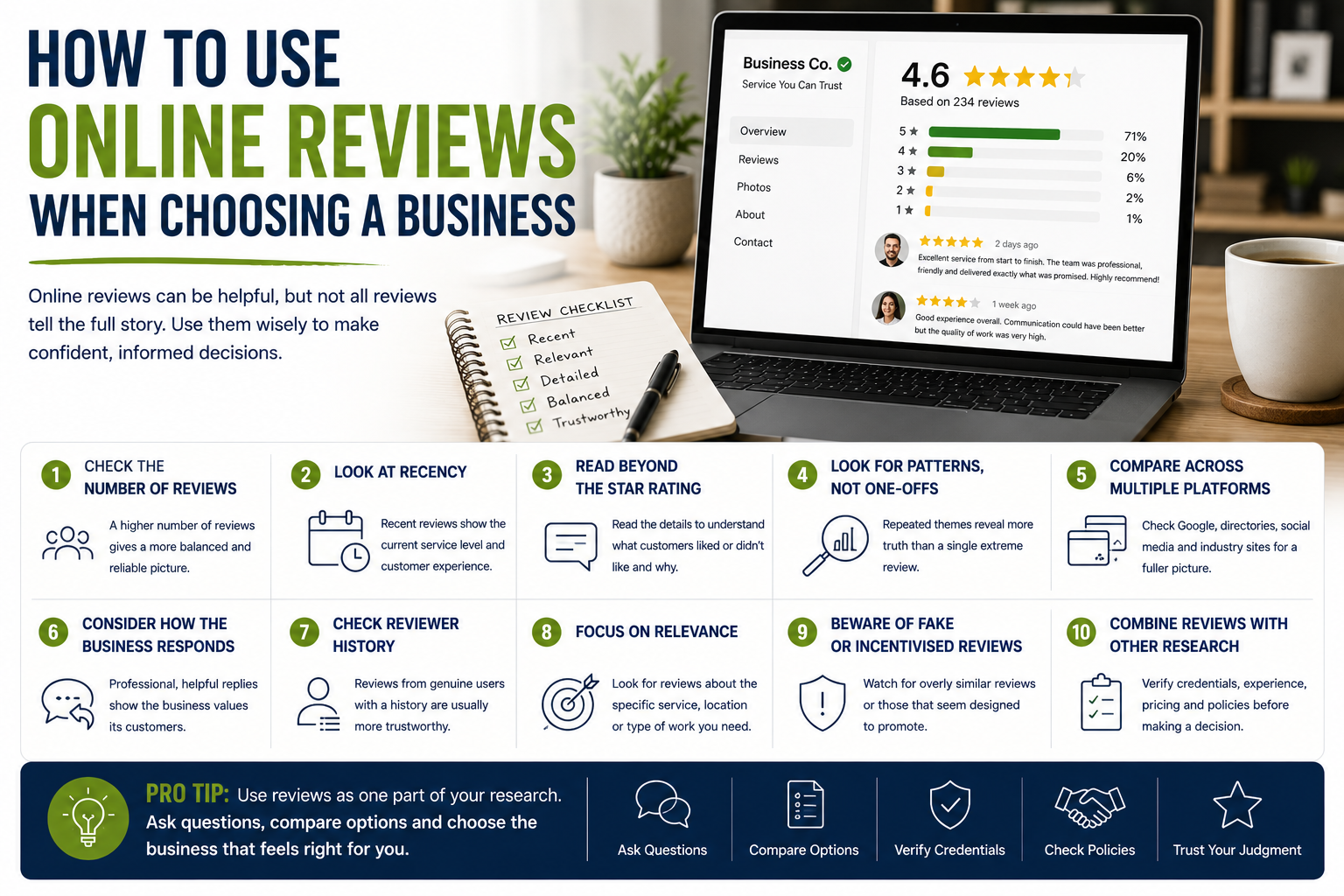
How to Use Online Reviews When Choosing a Business
Online reviews can help people compare businesses before making an enquiry, booking an appointment or purchasing a service.
They may provide useful information about communication, reliability, customer service, pricing and the overall experience. However, reviews are not always complete, balanced or easy to interpret.
A business with the highest average rating is not automatically the best choice. Some companies have only a small number of reviews, while others operate at a much larger scale and naturally receive a wider range of feedback.
The most useful approach is to read reviews critically, look for recurring patterns and combine them with other evidence.
Start With the Number of Reviews
An average rating is more meaningful when it is supported by a reasonable number of reviews.
For example, a business with five perfect reviews may appear stronger than one with several hundred reviews and a slightly lower rating.
However, the larger business may have:
- Served many more customers
- Operated for longer
- Collected feedback consistently
- Experienced a broader range of situations
Review volume does not prove quality, but it provides useful context.
Consider:
- How many reviews exist?
- Over what period were they posted?
- Are reviews still being added?
- Does the number seem realistic for the size of the business?
- Are reviews spread across more than one platform?
A rating should never be assessed without considering the quantity behind it.
Look at How Recent the Reviews Are
Recent reviews usually provide a better picture of the current business.
Companies can change because of:
- New ownership
- Different staff
- Improved processes
- Expansion
- Reduced staffing
- New suppliers
- Policy changes
- Management problems
A business may have a strong overall rating based mainly on reviews from several years ago.
Check whether recent customers describe the same experience.
Pay particular attention to reviews from the previous six to twelve months when available.
Older reviews can still be useful for identifying long-term patterns, but they should not automatically outweigh more current feedback.
Read Beyond the Star Rating
Star ratings provide a quick summary but often hide important detail.
Two customers may both leave four stars for very different reasons.
One may have received excellent service but experienced a minor delay. Another may have had a mixed experience but still considered the business acceptable overall.
The written review may reveal information about:
- Communication
- Punctuality
- Workmanship
- Responsiveness
- Pricing
- Staff behaviour
- Problem resolution
- Aftercare
Read a selection of positive, neutral and negative reviews.
This provides a more balanced understanding than reading only the highest-rated comments.
Look for Repeated Themes
One review may describe an unusual experience.
Several reviews mentioning the same issue are more significant.
Repeated positive themes may include:
- Clear communication
- Friendly staff
- Reliable appointments
- Good organisation
- Transparent pricing
- Strong aftercare
- Consistent quality
Repeated concerns may include:
- Missed calls
- Unexpected charges
- Delays
- Poor communication
- Difficult refunds
- Unresolved complaints
- Inconsistent workmanship
Patterns matter more than isolated statements.
A single complaint about lateness may have many possible explanations. Numerous complaints about missed appointments suggest a broader operational problem.
Consider the Type of Business
Reviews should be interpreted in the context of the service.
A restaurant, healthcare clinic, software provider and building contractor will generate different kinds of feedback.
For example, reviews of a contractor may focus on:
- Quotations
- Timelines
- Workmanship
- Cleanliness
- Variations
- Completion
Reviews of a clinic may focus on:
- Appointment organisation
- Communication
- Staff behaviour
- Accessibility
- Fees
- Overall experience
The most relevant reviews are those describing situations similar to your own.
A review of a small repair may provide limited insight into how the same company handles a major renovation.
Compare Reviews Across Several Platforms
Do not rely entirely on one review website.
Different platforms may attract different audiences and feedback styles.
Possible sources include:
- Industry directories
- Professional associations
- Social media
- Marketplace platforms
- Independent review websites
- Local business directories
A business may have strong feedback on one platform and repeated concerns on another.
Comparing several sources can help identify whether the overall reputation is consistent.
Where possible, also check:
- The business website
- Professional registration
- Case studies
- Local mentions
- Official complaints information
Reviews should form one part of the decision rather than the entire decision.
Be Cautious With Extremely Vague Reviews
Very short reviews may still be genuine, but they provide limited evidence.
Examples include:
- Great service
- Highly recommended
- Excellent company
- Five stars
- Amazing experience
More useful reviews usually contain specific details.
They may mention:
- The service purchased
- The type of problem
- How communication was handled
- What happened when an issue arose
- Whether the final result matched expectations
Specificity makes a review easier to evaluate.
Watch for Repeated Wording
Several reviews using nearly identical phrases may deserve closer attention.
Possible signs include:
- The same sentence structure
- Repeated promotional language
- Identical spelling patterns
- Similar claims posted close together
- Frequent use of the business name
- Language that resembles website copy
This does not prove that reviews are false.
Customers may sometimes follow prompts or use suggested wording.
However, a large number of highly similar reviews can make the feedback less informative.
Consider the Reviewer’s History
Some platforms allow users to view a reviewer’s previous activity.
This can provide additional context.
A reviewer may appear more credible when they have:
- Reviewed several unrelated businesses
- Posted over a long period
- Included specific details
- Used a normal range of ratings
- Uploaded relevant photographs
Be cautious when an account:
- Has posted only one review
- Was created recently
- Leaves only extreme ratings
- Reviews several related businesses in a short period
- Uses highly promotional language
Reviewer history is not always available, but it can be useful when it is.
Do Not Dismiss Every Negative Review
No established business is likely to satisfy every customer.
Negative feedback may result from:
- Miscommunication
- Unrealistic expectations
- Delays
- Errors
- Personality differences
- Genuine service failures
The existence of a negative review is not necessarily a reason to avoid the business.
The more useful questions are:
- What happened?
- Does the complaint seem specific?
- Did the business respond?
- Was the issue resolved?
- Do other reviews mention the same problem?
A small number of well-handled complaints can sometimes provide more confidence than a profile containing only perfect feedback.
Look at How the Business Responds
Review responses can reveal how a company handles praise, criticism and conflict.
Positive signs may include:
- A polite tone
- Acknowledgement of the concern
- A clear next step
- An invitation to discuss the issue privately
- Protection of confidential information
- A willingness to investigate
Warning signs may include:
- Aggressive replies
- Personal attacks
- Public disclosure of private information
- Dismissive language
- Blaming every customer
- Repeated generic responses
- No response to serious complaints
A professional response does not prove that the business was correct, but it can show a willingness to manage concerns constructively.
Be Alert to Confidentiality Problems
Businesses in healthcare, legal, financial and other sensitive sectors should be especially careful when responding publicly.
They should not reveal:
- Health information
- Legal details
- Financial information
- Personal circumstances
- Private correspondence
- Appointment history
A response that exposes confidential information should be treated seriously.
Professionalism includes protecting privacy even during a disagreement.
Check Whether Reviews Match the Service You Need
A business may have strong overall feedback while receiving mixed reviews for one particular service.
For example, a company may be highly rated for routine maintenance but less experienced with large projects.
Search reviews for references to:
- The specific service
- Your location
- Similar project size
- Similar property type
- Similar customer needs
- Comparable timescales
Relevant reviews are more useful than general praise.
Look for Evidence of Problem Resolution
Mistakes can happen in any business.
What matters is how they are handled.
Useful reviews may explain that the business:
- Returned to correct an issue
- Provided a refund
- Replaced a faulty product
- Explained a delay
- Rebooked an appointment
- Assigned a senior staff member
- Followed up after completion
This can provide insight into aftercare.
A business that resolves occasional problems well may be a safer choice than one that appears perfect until something goes wrong.
Treat Emotional Reviews Carefully
Some reviews are written immediately after a frustrating or highly positive experience.
Emotion does not make them invalid, but it can affect balance.
Look for:
- Specific facts
- Dates
- Clear explanations
- Evidence of attempted resolution
- Details relevant to the service
A review containing only anger or praise without explanation may be less useful than one that describes what occurred.
Consider Whether Expectations Were Clear
Some complaints result from a mismatch between what the customer expected and what the business agreed to provide.
This may involve:
- Price
- Scope
- Delivery time
- Refund terms
- Appointment length
- Materials
- Results
When reading a negative review, ask whether it is clear what was originally agreed.
The business may still have communicated poorly, but understanding the expectation helps interpret the complaint.
Review Photographs Carefully
Customer photographs can provide useful evidence.
They may show:
- Completed work
- Product condition
- Venue cleanliness
- Packaging
- Property damage
- Presentation
- Before-and-after results
However, images can lack context.
They may not show:
- When the photograph was taken
- Whether the work was complete
- Which business performed the work
- What was agreed
- Whether the issue was later corrected
Photographs should support the review, not replace critical judgement.
Check for Sudden Review Spikes
A large number of reviews posted within a short period may have a reasonable explanation.
The business may have:
- Started requesting feedback
- Completed a busy campaign
- Sent a customer email
- Launched on a new platform
However, sudden clusters of very similar reviews may deserve closer inspection.
Check whether:
- The wording varies
- The reviews describe different services
- The accounts appear genuine
- Review activity continues afterwards
A natural review profile usually develops over time.
Be Cautious With Review Incentives
Some businesses offer incentives for feedback.
This may include:
- Discounts
- Prize draws
- Free products
- Loyalty points
Incentivised reviews are not automatically dishonest, but the incentive can influence who responds and how positively they write.
Where incentives are used, they should ideally be disclosed and should not depend on leaving a positive rating.
A request for honest feedback is different from rewarding only favourable reviews.
Understand That Absence of Reviews Is Not Proof of Poor Quality
New, small or referral-based businesses may have few online reviews.
They may rely more heavily on:
- Repeat customers
- Word-of-mouth referrals
- Professional networks
- Long-term contracts
- Offline reputation
A lack of reviews means there is less public evidence, not necessarily that the business is unsuitable.
In this situation, ask for:
- References
- Case studies
- Examples of work
- Professional credentials
- Written quotations
- Insurance details
Other forms of verification become more important.
Do Not Rely on Testimonials Alone
Testimonials displayed on a business website are selected by the business.
They can still be useful, particularly when they include:
- Named clients
- Specific services
- Detailed outcomes
- Verifiable organisations
- Relevant context
However, testimonials are unlikely to show the full range of customer experiences.
Compare them with independent sources where possible.
Look for Realistic Claims
Be cautious when reviews or promotional content suggest:
- Guaranteed outcomes
- Instant success
- Perfect results for everyone
- No risks
- Complete certainty
This is particularly important in:
- Healthcare
- Legal services
- Finance
- Marketing
- Education
- Property investment
Results often depend on factors outside the business’s control.
Credible businesses usually communicate limitations and avoid unrealistic promises.
Use Reviews to Prepare Questions
Reviews can help identify questions to ask before making a decision.
For example, repeated comments about delays may prompt you to ask:
- What is the expected timeline?
- How are delays communicated?
- How many projects are managed at once?
Comments about unexpected costs may lead to questions such as:
- What is included?
- What may cost extra?
- How are changes approved?
- Is VAT included?
Reviews are most valuable when they improve the selection process rather than replace it.
Verify Professional Credentials Separately
Reviews do not prove that a business or practitioner holds the required qualifications.
Where relevant, check:
- Professional registration
- Licensing
- Insurance
- Company details
- Trade memberships
- Accreditation
Use official sources where possible.
A highly rated provider may still lack credentials required for a specific type of work.
Compare Price and Value Separately
Some negative reviews focus mainly on cost.
A high price is not automatically unfair, and a low price is not automatically good value.
Consider whether the business clearly explained:
- The service
- The price
- Additional charges
- Payment terms
- Cancellation
- Deliverables
A review saying that a service was expensive may be less concerning when the cost was transparent and the work was completed properly.
Unexpected or unexplained charges are more significant.
Create a Simple Review Checklist
When comparing businesses, record:
| Factor | Business A | Business B | Business C |
|---|---|---|---|
| Average rating | |||
| Number of reviews | |||
| Recent feedback | |||
| Repeated strengths | |||
| Repeated concerns | |||
| Response quality | |||
| Relevant reviews | |||
| Other credentials | |||
| Pricing clarity | |||
| Overall confidence |
This can reduce the temptation to choose based only on the highest rating.
Questions to Ask Before Choosing a Business
Useful questions include:
- Have you completed similar work?
- What is included in the price?
- Who will deliver the service?
- What happens if there is a problem?
- Can you provide recent references?
- What qualifications or insurance apply?
- What are the cancellation terms?
- How are additional costs approved?
- What is the expected timeline?
- Who should I contact with concerns?
Clear answers should support, not contradict, the impression created by reviews.
Warning Signs
Potential warning signs include:
- Many highly similar reviews
- Sudden unexplained review spikes
- Repeated unresolved complaints
- Aggressive responses
- Public disclosure of private information
- Reviews inconsistent with official credentials
- Guaranteed outcomes
- Pressure to decide immediately
- No clear business details
- Serious concerns repeated across several platforms
Several warning signs should encourage further checks.
Final Thoughts
Online reviews can provide valuable insight into how a business communicates, delivers services and responds when something goes wrong.
They are most useful when read in context.
Review quantity, recency, detail, relevance and repeated themes all matter more than the headline rating alone.
Compare feedback across several sources, verify important credentials independently and use reviews to prepare better questions.
The strongest decision usually combines customer experience with clear pricing, appropriate qualifications, relevant evidence and confidence in the way the business communicates.