10 Questions to Ask Before Hiring a Home-Improvement Contractor
Hiring a contractor for building, renovation or repair work can involve a significant financial commitment.
Whether the project is a home extension, loft conversion, kitchen renovation, bathroom installation, electrical upgrade or general refurbishment, the quality of the contractor can affect the cost, timeline and final result.
A professional appearance or competitive quotation does not automatically mean that a contractor is the right choice. Homeowners should ask clear questions, compare several providers and make sure important details are confirmed in writing before work begins.
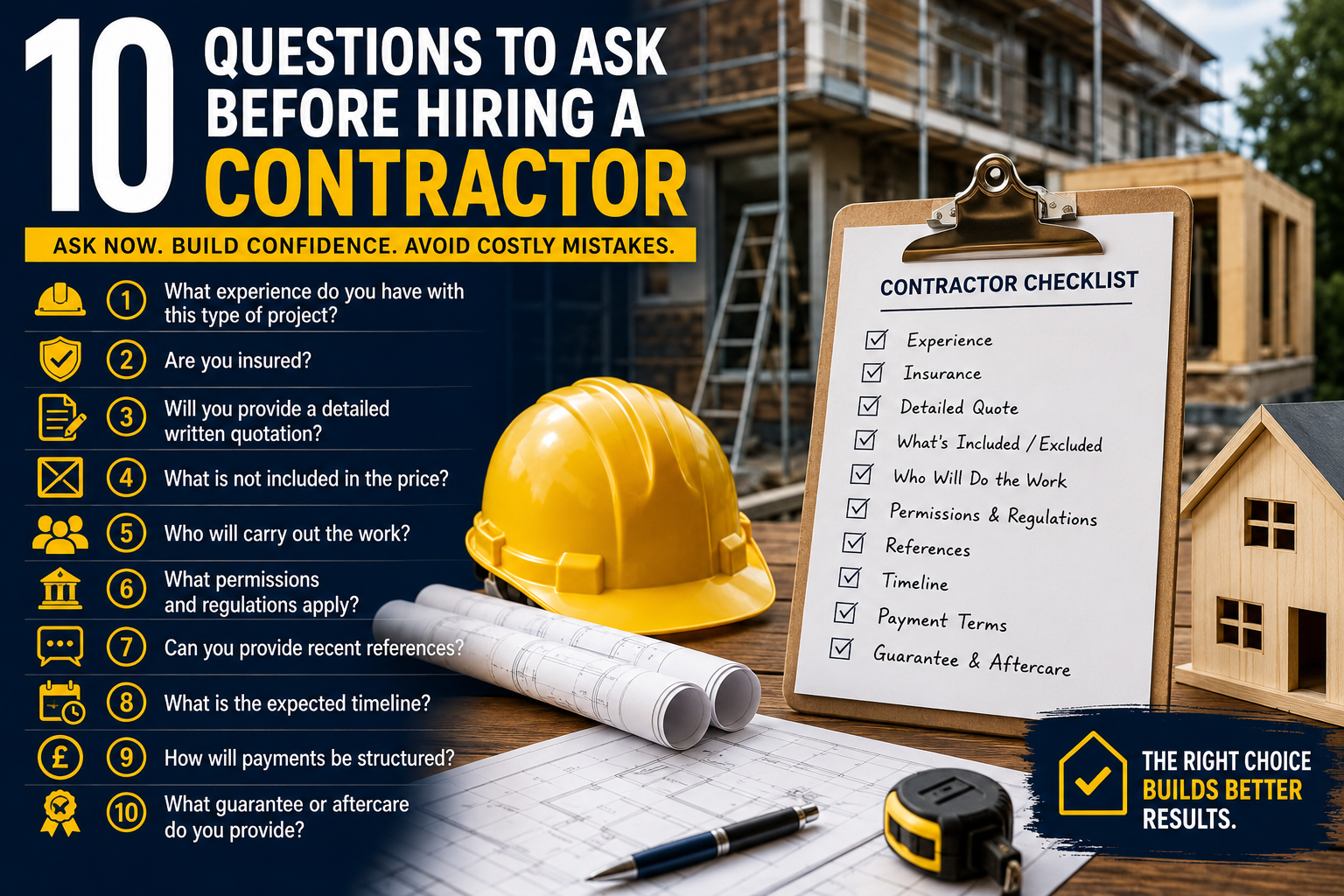
Here are ten useful questions to ask before hiring a home-improvement contractor.
1. What Experience Do You Have With This Type of Project?
A contractor may have many years of experience without having completed projects similar to yours.
Ask about:
- Comparable projects
- Property types
- Project scale
- Materials used
- Technical challenges
- Local experience
- Relevant specialist work
For example, a contractor experienced in new-build properties may not automatically be the best choice for renovating an older home with structural or conservation considerations.
A useful answer should include specific examples rather than general assurances.
Where possible, ask to see photographs, case studies or references from similar work.
2. Are You Insured?
Contractors should have appropriate insurance for the work they carry out.
Depending on the project, this may include:
- Public liability insurance
- Employers’ liability insurance
- Professional indemnity insurance
- Contract works insurance
Ask for current insurance details rather than relying on a verbal statement.
Check:
- The insurer
- The policy period
- The level of cover
- Whether the work is included
- Whether subcontractors are covered
Insurance does not guarantee quality, but it can provide important protection if damage, injury or another serious problem occurs.
Homeowners should also speak with their own insurer before major work begins, as building projects can affect existing home-insurance cover.
3. Will You Provide a Detailed Written Quotation?
A written quotation should explain what the contractor is proposing to do and how the price has been calculated.
It should ideally include:
- Labour
- Materials
- Equipment
- Waste removal
- Subcontractor costs
- VAT
- Estimated start date
- Estimated completion date
- Payment schedule
- Exclusions
Avoid relying on a single total without a clear description of the work.
A vague quotation makes it difficult to compare contractors and increases the risk of disagreements later.
It is also important to understand whether the document is:
- A fixed quotation
- An estimate
- A budget allowance
- A provisional price
These terms can have different implications.
4. What Is Not Included in the Price?
Exclusions can be just as important as included work.
Ask whether the quotation excludes:
- Planning fees
- Building-control fees
- Structural-engineer fees
- Architect costs
- Decoration
- Flooring
- Fixtures
- Appliances
- Waste removal
- Scaffolding
- Utility connections
- Unexpected repairs
Some elements may be left as provisional sums because the final cost cannot be confirmed until the work begins.
The contractor should explain which costs may change and why.
A cheaper quotation may simply exclude more work than a higher one.
5. Who Will Carry Out the Work?
The person who prepares the quotation may not be the person completing the project.
Ask:
- Who will manage the work?
- Who will be on site each day?
- Will subcontractors be used?
- Which trades will be involved?
- Who is responsible for quality control?
- Who should be contacted with questions?
- Who will hold keys or access the property?
Subcontracting is common and not necessarily a concern.
However, the main contractor should remain responsible for coordination, communication and the agreed standard of work.
Homeowners should know who is accountable for the project.
6. Can You Provide Recent References?
Recent references can offer useful insight into how a contractor works.
Ask previous customers about:
- Communication
- Reliability
- Punctuality
- Cleanliness
- Budget management
- Problem-solving
- Workmanship
- Completion time
- Aftercare
Useful questions include:
- Was the final price close to the quotation?
- Were changes explained clearly?
- Did the contractor attend consistently?
- Were problems handled professionally?
- Would you use the contractor again?
Online reviews can also be helpful, but direct references may provide more detailed information.
Be cautious if a contractor cannot provide any recent examples of completed work.
7. What Permissions and Regulations Apply?
Some projects require planning permission, building-regulation approval or other formal consent.
Ask who is responsible for:
- Planning applications
- Building notices
- Full plans applications
- Structural calculations
- Party wall matters
- Listed-building consent
- Conservation-area requirements
- Permitted-development checks
- Inspections
- Completion certificates
Do not assume the contractor will handle every requirement unless this is confirmed in writing.
Even when planning permission is not needed, building regulations may still apply.
Homeowners remain responsible for making sure the work is lawful and properly documented.
Specialist advice may be necessary for complex projects.
8. What Is the Expected Timeline?
Ask for a realistic project programme rather than a broad promise.
The timeline should consider:
- Start date
- Project stages
- Material lead times
- Inspections
- Subcontractor availability
- Weather
- Access
- Drying times
- Possible delays
- Completion date
Homeowners should also ask:
- How many projects will the contractor manage at the same time?
- Will workers attend every day?
- What happens if the project falls behind?
- How will delays be communicated?
- Are there any seasonal risks?
No contractor can guarantee that every project will proceed without delay.
The important issue is whether the timetable is realistic and whether changes will be communicated clearly.
9. How Will Payments Be Structured?
The payment schedule should reflect the progress of the project.
Common arrangements may include:
- A deposit
- Stage payments
- Payments after inspections
- Final payment on completion
- Retention until outstanding work is resolved
Avoid paying the entire amount in advance.
A contractor may reasonably request money for materials or initial mobilisation, but the arrangement should be proportionate and documented.
Ask:
- How much is required upfront?
- When are stage payments due?
- What evidence of progress will be provided?
- How are additional costs approved?
- When is the final balance payable?
- What payment methods are accepted?
Payments should be traceable. Receipts and invoices should be retained.
10. What Guarantee or Aftercare Do You Provide?
Ask what happens if a problem appears after completion.
The contractor should explain:
- What workmanship guarantee applies
- How defects are reported
- How quickly issues are reviewed
- Which materials have manufacturer warranties
- Whether certificates will be supplied
- What is excluded from the guarantee
- Whether aftercare is provided in writing
A guarantee is only useful if the contractor remains contactable and willing to deal with legitimate issues.
Homeowners should also retain:
- Contracts
- Quotations
- Invoices
- Certificates
- Product warranties
- Photographs
- Correspondence
- Completion documents
These records may be important for future maintenance, insurance or property sales.
Additional Questions Worth Asking
Depending on the project, homeowners may also wish to ask:
- How will the property be protected?
- Where will materials be stored?
- How will waste be removed?
- What working hours are expected?
- How will neighbours be affected?
- Will water or electricity be unavailable?
- Who is responsible for site security?
- How will dust and noise be controlled?
- What happens if hidden damage is discovered?
- How are design changes approved?
The larger the project, the more important it becomes to document expectations in advance.
Compare More Than Price
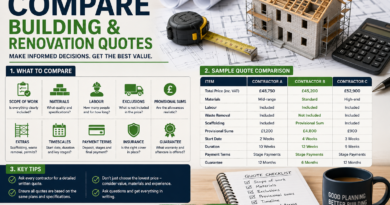
It is sensible to obtain more than one quotation.
However, quotations should be compared carefully.
A lower price may reflect:
- Fewer included items
- Cheaper materials
- Less labour
- Missing fees
- Unrealistic timings
- Lower insurance cover
- Greater use of provisional sums
A higher quotation may include more comprehensive work.
Create a comparison based on:
- Scope
- Materials
- Timescale
- Payment terms
- Insurance
- References
- Communication
- Guarantees
- Exclusions
- Overall confidence
Price matters, but it should not be the only factor.
Put the Agreement in Writing
A written contract can reduce uncertainty and provide a clear reference if a disagreement occurs.
The agreement should cover:
- Contractor details
- Property address
- Scope of work
- Drawings and specifications
- Price
- Payment schedule
- Start date
- Completion expectations
- Materials
- Subcontractors
- Insurance
- Variations
- Delays
- Waste removal
- Guarantees
- Dispute procedures
Any changes should also be recorded in writing.
Verbal agreements are difficult to prove and can be remembered differently by each party.
Be Clear About Variations
Changes often occur during building projects.
A homeowner may request an upgrade, or the contractor may discover an unexpected issue.
Before additional work is carried out, ask for:
- A description of the change
- The additional cost
- The effect on the timeline
- Any material differences
- Written approval
Uncontrolled variations are one of the main reasons projects exceed their original budget.
A simple written approval process can reduce disputes.
Watch for Warning Signs
Potential warning signs include:
- Pressure to decide immediately
- Requests for large cash payments
- No written quotation
- Unclear business details
- No insurance evidence
- Refusal to provide references
- Prices far below other quotations
- Evasive answers
- No fixed address or contact details
- Demands for full payment upfront
- Reluctance to discuss permissions
- No written contract
One concern may have a reasonable explanation, but several warning signs should encourage greater caution.
Check the Contractor’s Business Details
Before committing, verify basic information such as:
- Trading name
- Legal business name
- Registered office
- Company registration, where applicable
- VAT status
- Telephone number
- Email address
- Website
- Insurance
- Professional memberships
Trade-association membership may offer reassurance, but it should still be verified directly.
Membership alone does not replace proper checks.
Prepare the Property Before Work Starts
Once a contractor has been selected, agree practical arrangements.
These may include:
- Access
- Keys
- Alarm systems
- Parking
- Storage
- Working hours
- Bathroom access
- Electricity and water
- Protection of furniture
- Pets
- Children
- Neighbour communication
Clear practical arrangements can help the project begin smoothly.
Maintain Regular Communication
Even with a detailed contract, regular communication remains important.
For larger projects, consider:
- Weekly progress meetings
- Written updates
- Photographs
- Budget reviews
- Decision deadlines
- Updated programmes
- Records of agreed changes
Questions should be raised early.
Small misunderstandings are usually easier to resolve before they affect cost or progress.
Final Thoughts
Choosing a home-improvement contractor requires more than comparing prices.
Experience, insurance, scope, references, payment terms, communication and aftercare should all be considered before work begins.
A reliable contractor should be willing to answer reasonable questions and provide important information in writing.
Taking time to check the details at the beginning can reduce the risk of unexpected costs, delays and disputes later.
For larger or technically complex projects, homeowners may also benefit from independent advice from an architect, surveyor, structural engineer or other appropriately qualified professional.