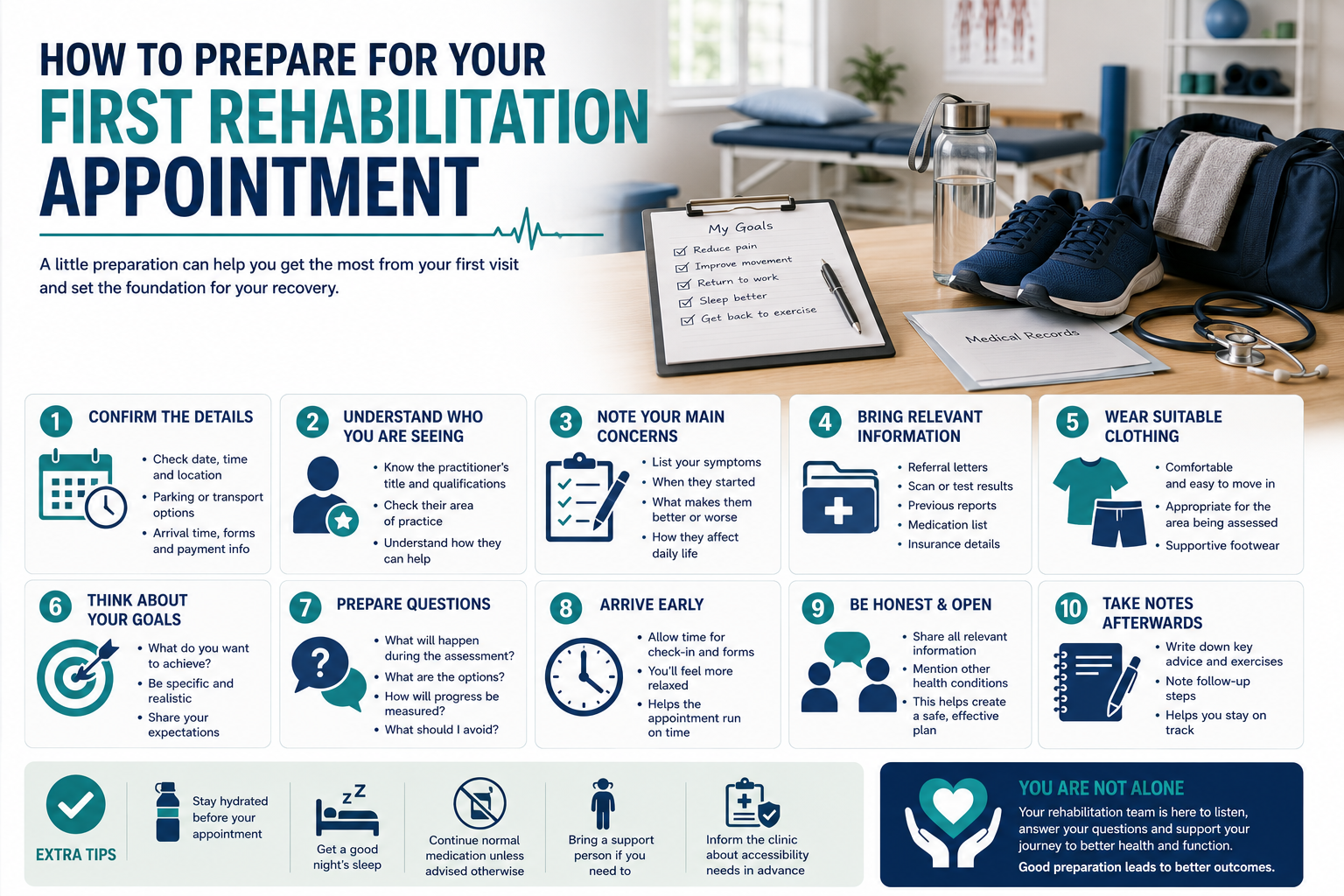
How to Prepare for Your First Rehabilitation Appointment
A first rehabilitation appointment is an opportunity to explain what has been happening, discuss how the problem affects daily life and understand what the next steps may involve.
Depending on the clinic and practitioner, the appointment may include a detailed conversation, physical assessment, movement testing, review of previous treatment and discussion of possible goals.
Preparing in advance can make the appointment more useful and help the practitioner understand your situation more clearly.
The exact process varies between professions and clinics, but the following steps can help you feel more prepared.
Confirm the Appointment Details
Before attending, check:
- The date and time
- The clinic address
- Parking or public transport options
- Accessibility
- The practitioner’s name
- The appointment length
- Whether forms must be completed
- Whether payment is required
- The cancellation policy
- What identification or documents are needed
Some clinics send digital intake forms before the appointment.
Completing these in advance can save time and give the practitioner useful background information.
If you need step-free access, an interpreter, a support person or another accommodation, contact the clinic before attending.
Understand Which Practitioner You Are Seeing
Rehabilitation may involve different professionals, including:
- Physiotherapists
- Chiropractors
- Occupational therapists
- Massage therapists
- Sports rehabilitation professionals
- Medical practitioners
- Other regulated healthcare providers
Each profession has a different scope of practice.
Before attending, check:
- The practitioner’s title
- Their qualifications
- Their area of practice
- Whether they are regulated
- What the appointment is intended to assess
This can help you prepare suitable questions and understand what the practitioner may be able to provide.
Write Down Your Main Concerns
It can be difficult to remember everything during an appointment.
Before attending, make a short list of the main issues you want to discuss.
This may include:
- Pain
- Weakness
- Reduced movement
- Tingling or numbness
- Balance problems
- Difficulty walking
- Problems using an arm or hand
- Sleep disruption
- Difficulty working
- Difficulty exercising
- Concerns about returning to activity
Try to identify which issue affects you most.
This can help the practitioner prioritise the assessment.
Note When the Problem Started
The practitioner may ask about the history of the problem.
Useful details include:
- When symptoms began
- Whether they started suddenly or gradually
- Whether there was an injury
- Whether symptoms have changed
- What makes them better
- What makes them worse
- Whether they are constant or intermittent
- Whether they affect sleep
- Whether they spread to another area
- Whether similar problems have happened before
You do not need to provide a perfect medical timeline.
A rough sequence of events is usually more helpful than trying to remember every date precisely.
Describe How the Problem Affects Daily Life
Rehabilitation is often focused on function rather than symptoms alone.
Think about activities that have become difficult.
Examples may include:
- Getting dressed
- Climbing stairs
- Lifting
- Driving
- Working at a desk
- Standing for long periods
- Walking
- Caring for children
- Sleeping
- Exercising
- Returning to sport
- Completing household tasks
Specific examples help the practitioner understand the practical impact.
For example:
I can walk for about ten minutes before the pain increases.
This is often more useful than saying:
Walking is difficult.
Prepare a List of Current Medications
Bring an up-to-date list of medications and supplements.
Include:
- Medication name
- Dose
- How often it is taken
- Why it is taken, if known
- Recent changes
- Allergies or reactions
Some medications can affect pain, balance, fatigue, healing or exercise tolerance.
Do not stop or change medication without speaking with the appropriate prescribing professional.
Bring Relevant Medical Information
If available and relevant, bring:
- Referral letters
- Imaging reports
- Scan results
- Discharge summaries
- Previous assessment reports
- Surgical information
- Specialist letters
- Insurance forms
- Workplace documents
- Exercise plans
- Previous rehabilitation notes
You may not need to bring every medical document you have.
Focus on information connected to the current concern.
If the clinic already has access to the records, confirm this before attending.
Wear Suitable Clothing
You may be asked to move, walk, bend or complete simple physical tests.
Wear clothing that is:
- Comfortable
- Easy to move in
- Appropriate for the area being assessed
- Easy to adjust if necessary
Depending on the concern, suitable clothing may include:
- Shorts
- A loose top
- Sports clothing
- Supportive footwear
- Clothing without restrictive layers
Ask the clinic if you are unsure what to wear.
You should also be offered appropriate privacy and draping during any physical assessment.
Bring the Shoes or Equipment You Normally Use
If the problem relates to walking, running, work or sport, bring relevant equipment.
This may include:
- Everyday shoes
- Running shoes
- Work boots
- Orthotics
- Braces
- Walking aids
- Sports equipment
- Splints
- Support garments
The practitioner may wish to see how you use them or whether they affect movement.
Do not bring large equipment unless the clinic confirms it would be useful.
Think About Your Goals
The practitioner may ask what you hope to achieve.
Goals can be practical and specific.
Examples include:
- Walking to the local shops
- Returning to work
- Sleeping more comfortably
- Lifting a child
- Using stairs
- Driving
- Returning to running
- Improving balance
- Completing household tasks
- Managing symptoms more confidently
Goals do not need to be ambitious.
A realistic short-term goal can help guide the rehabilitation plan.
Prepare Questions
Writing down questions can help you remember them.
Useful questions may include:
- What will happen during today’s assessment?
- What may be contributing to the problem?
- Is any further assessment needed?
- What are the available options?
- What can I do between appointments?
- How will progress be measured?
- How often might appointments be needed?
- What should I avoid?
- When should I seek further medical advice?
- What are the fees and cancellation terms?
A responsible practitioner should be willing to explain recommendations clearly.
Be Ready to Discuss Previous Treatment
The practitioner may ask what you have already tried.
This could include:
- Medication
- Exercise
- Rest
- Physiotherapy
- Chiropractic care
- Massage
- Acupuncture
- Surgery
- Injections
- Bracing
- Home remedies
- Online exercise programmes
Explain:
- What was tried
- For how long
- Whether it helped
- Whether it made symptoms worse
- Why it stopped
This can help avoid repeating an approach that was unsuitable or ineffective.
Explain Relevant Health Conditions
The practitioner may need to know about other health issues.
Examples may include:
- Heart conditions
- High blood pressure
- Diabetes
- Neurological conditions
- Osteoporosis
- Previous fractures
- Cancer history
- Pregnancy
- Recent surgery
- Balance problems
- Breathing conditions
This information can affect assessment and exercise planning.
Share relevant information honestly, even when it does not seem directly connected.
Mention Any Red-Flag Symptoms
Certain symptoms may require urgent medical assessment rather than routine rehabilitation.
Examples can include:
- Sudden severe weakness
- Loss of bladder or bowel control
- New difficulty speaking
- Chest pain
- Severe shortness of breath
- Sudden loss of coordination
- Significant unexplained weight loss
- Fever with severe pain
- Symptoms following major trauma
- Rapidly worsening neurological symptoms
This is not a complete list.
For urgent, severe or rapidly worsening symptoms, contact an appropriate medical service rather than waiting for a routine appointment.
Arrive a Little Early
Arriving early allows time for:
- Registration
- Forms
- Insurance details
- Payment
- Finding the treatment room
- Asking practical questions
Ten to fifteen minutes is often enough unless the clinic advises otherwise.
Arriving late may reduce the time available for assessment.
Bring a Support Person When Appropriate
You may wish to attend with a family member, friend, carer or interpreter.
A support person can help with:
- Communication
- Remembering information
- Mobility
- Emotional support
- Understanding instructions
Ask the clinic in advance whether another person can attend.
The practitioner should still direct questions to you and respect your consent and privacy.
Expect a Conversation Before Physical Assessment
The first part of the appointment often involves discussing:
- Symptoms
- Medical history
- Daily activities
- Work
- Exercise
- Sleep
- Previous treatment
- Goals
- Concerns
This conversation is an important part of the assessment.
It helps the practitioner decide which physical tests may be appropriate.
Understand That Assessment May Involve Movement Tests
Depending on the concern, the practitioner may assess:
- Posture
- Walking
- Balance
- Strength
- Joint movement
- Coordination
- Functional tasks
- Sensation
- Repeated movement
- Tolerance of activity
You should be told what is being assessed and why.
Tell the practitioner if a test feels uncomfortable, painful or unsafe.
You have the right to ask questions, pause or decline any part of the assessment.
Treatment May Not Begin Immediately
Some first appointments include treatment, while others focus mainly on assessment.
The practitioner may need to:
- Gather more information
- Review medical records
- Contact another professional
- Request further investigation
- Consider whether referral is needed
- Develop a rehabilitation plan
Do not assume that receiving more treatment during the first visit means the appointment was better.
A careful assessment may be more important than starting immediately.
Ask How Progress Will Be Measured
Progress may be assessed through:
- Pain levels
- Movement
- Strength
- Walking distance
- Work tolerance
- Sleep
- Activity levels
- Confidence
- Functional tests
- Goal completion
Improvement is not always linear.
Some people progress steadily, while others experience temporary setbacks.
The practitioner should explain what changes are being monitored and when the plan will be reviewed.
Ask About Home Exercises
If exercises are recommended, make sure you understand:
- What to do
- How often to do it
- How many repetitions
- What equipment is needed
- What discomfort may be acceptable
- When to stop
- What to do if symptoms worsen
Written or video instructions may be helpful.
Do not hesitate to ask the practitioner to demonstrate an exercise again.
Incorrect technique can reduce the benefit or aggravate symptoms.
Take Notes After the Appointment
Soon after the appointment, record:
- Main findings
- Recommended next steps
- Exercises
- Appointment frequency
- Referral advice
- Warning signs
- Follow-up date
- Questions to ask next time
This can be especially useful when a lot of information was discussed.
Some clinics may provide a written summary or exercise plan.
Review the Plan Before Agreeing to Ongoing Care
Before booking several appointments, make sure you understand:
- The goal of rehabilitation
- The recommended frequency
- Expected review points
- Fees
- Cancellation terms
- Home responsibilities
- Alternatives
- What happens if progress is limited
Be cautious about pressure to purchase a large prepaid package before the plan has been properly explained.
You should feel comfortable asking for time to consider the recommendation.
What to Avoid Before the Appointment
Unless advised otherwise, avoid:
- Starting an intense new exercise programme
- Changing medication
- Hiding important symptoms
- Taking unnecessary risks to “test” the injury
- Ignoring severe or rapidly worsening symptoms
- Assuming online information is a diagnosis
Continue normal activity only within safe and manageable limits.
Where you have received specific medical advice, follow that guidance.
Final Thoughts
Preparing for a first rehabilitation appointment can make it easier to explain your concerns and understand the proposed plan.
Confirm the practical details, bring relevant medical information, wear suitable clothing and think about how the problem affects your daily activities.
It can also help to prepare questions and identify a few realistic goals.
The first appointment should be a collaborative process. You should feel informed, respected and able to ask questions before agreeing to assessment or care.
For urgent, severe or unexplained symptoms, contact an appropriate medical professional or emergency service rather than waiting for a routine rehabilitation appointment.