10 Ways to Discover Emerging Artists
Discovering emerging artists can be one of the most rewarding ways to engage with contemporary art.
Artists at an earlier stage of their careers often experiment more freely, work closely with local communities and develop ideas outside established commercial systems. Their work may appear in graduate exhibitions, open studios, artist-led spaces, independent galleries, residencies and online platforms long before it reaches major institutions.
Finding artists worth following does not require specialist knowledge or a large collecting budget. It mainly requires curiosity, regular exploration and a willingness to look beyond the most familiar names.
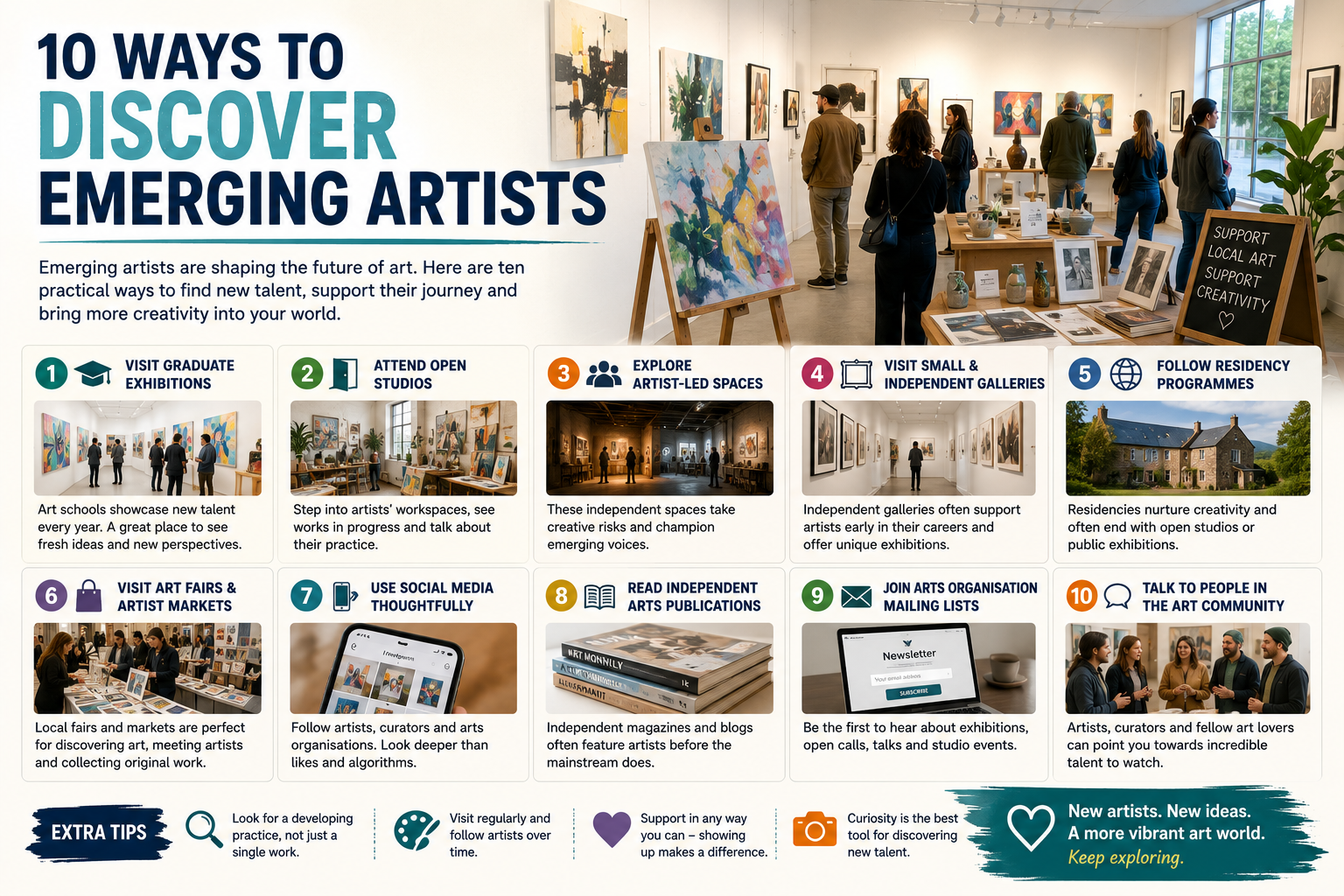
Here are ten practical ways to discover emerging artists.
1. Visit Graduate Exhibitions
Art schools and universities regularly present final-year and postgraduate exhibitions.
These shows can offer an early view of artists who are beginning to establish their professional practices.
Graduate exhibitions may include:
- Painting
- Sculpture
- Printmaking
- Photography
- Film
- Installation
- Performance
- Illustration
- Textiles
- Digital art
Visitors can often speak directly with the artists and learn more about their work, influences and future plans.
Graduate shows are particularly useful because they bring many practices together in one place.
When visiting, look beyond technical skill alone. Consider:
- Is the artist developing a recognisable body of work?
- Are the ideas coherent?
- Does the work stay in your mind afterwards?
- Is there evidence of experimentation?
- Would you like to see how the practice develops?
Not every artist will continue working professionally, but graduate exhibitions remain an important place to encounter new creative voices.
2. Attend Open Studios
Open studios allow artists to invite the public into their working spaces.
These events may take place in:
- Shared studio buildings
- Artist collectives
- Converted industrial spaces
- Community arts centres
- Independent workshops
- Private studios
Open studios offer something that galleries cannot always provide: direct insight into how the work is made.
Visitors may see:
- Works in progress
- Sketchbooks
- Materials
- Tools
- Experiments
- Earlier pieces
- Unfinished ideas
Speaking with the artist can reveal the decisions, research and processes behind the finished work.
Open studios are also useful for discovering artists who may not yet have commercial gallery representation.
3. Explore Artist-Led Spaces
Artist-led spaces are usually created or managed by artists themselves.
They may organise:
- Exhibitions
- Residencies
- Talks
- Workshops
- Performances
- Publications
- Collaborative projects
These spaces often provide opportunities for artists who are still developing their careers or whose work does not fit easily within commercial galleries.
Because they are less dependent on sales, artist-led organisations may take greater curatorial risks.
Their programmes can introduce visitors to:
- Experimental practices
- New media
- Site-specific work
- Socially engaged art
- Interdisciplinary projects
- Collaborative work
Follow local artist-led spaces online and join their mailing lists. Many operate with limited promotional budgets, so their strongest events may not receive wide media coverage.
4. Visit Small and Independent Galleries
Independent galleries often support artists before larger institutions or commercial galleries take an interest.
Smaller galleries may offer:
- Solo exhibitions
- Group shows
- Early-career programmes
- Open-call exhibitions
- Local artist showcases
- Affordable works
- Artist talks
Gallery staff can also be a valuable source of information.
Ask:
- Which artists are new to the programme?
- Are there upcoming exhibitions?
- Does the gallery represent early-career artists?
- Are studio visits or talks available?
- Is there a mailing list?
A good independent gallery does more than display work. It helps audiences understand the artist’s practice and provides context for the exhibition.
5. Follow Residency Programmes
Artist residencies give artists time, space and support to develop new work.
Residencies may be hosted by:
- Galleries
- Universities
- Museums
- Arts charities
- Rural organisations
- International cultural programmes
- Private foundations
- Community projects
Many residency programmes conclude with:
- Open studios
- Presentations
- Exhibitions
- Talks
- Publications
- Online showcases
Artists selected for residencies are often at an interesting point in their development.
They may be testing new materials, responding to a place or beginning a new body of work.
Following residency organisations can reveal artists before their work becomes widely known.
6. Attend Local Art Fairs and Independent Markets
Not every worthwhile art fair is a large international event.
Smaller regional fairs, artist markets and print fairs can be excellent places to discover new work.
These events may feature:
- Original artworks
- Prints
- Artist books
- Ceramics
- Photography
- Textiles
- Illustration
- Small editions
Artists often sell directly at these events, making it easier to ask questions and understand the work.
Independent fairs can also be more accessible for first-time collectors because they often include work at a wider range of prices.
When considering a purchase, ask about:
- Materials
- Edition size
- Framing
- Care
- Authenticity
- The artist’s wider practice
The aim should not be to identify an investment opportunity. It should be to find work that feels meaningful and that you would be pleased to live with.
7. Use Social Media Thoughtfully
Social media has become an important way for artists to share their work.
Useful platforms may include:
- YouTube
- TikTok
- Substack
- Online portfolio platforms
Rather than following only large art accounts, look for:
- Local studios
- Arts organisations
- Independent curators
- Graduate programmes
- Open-call platforms
- Artist-run projects
- Regional exhibitions
Artists often tag:
- Their studio
- Their gallery
- Their materials
- The exhibition
- Collaborators
- Residency programmes
Following these connections can lead from one artist to another.
However, social media visibility should not be confused with artistic quality.
Algorithms tend to reward work that photographs well, fits popular styles or generates quick engagement. Some strong practices are difficult to appreciate through a small screen.
Use social media as a starting point, then seek out full portfolios, exhibitions and longer-form interviews.
8. Read Independent Arts Publications
Independent magazines, newsletters, blogs and journals often cover artists who receive little attention from major media outlets.
Useful content may include:
- Artist interviews
- Studio visits
- Exhibition reviews
- Portfolio features
- Curatorial essays
- Regional round-ups
- Residency reports
- Open-call announcements
Independent publications can help readers understand not only what an artist makes, but why the work matters.
Look for publications with:
- Clear editorial standards
- Named contributors
- Original interviews
- Thoughtful criticism
- Transparent commercial relationships
- Good-quality images
- Links to artists’ official websites
Reading regularly can also help you identify recurring names and emerging themes.
9. Join Arts Organisation Mailing Lists
Mailing lists remain one of the best ways to hear about smaller exhibitions and events.
Subscribe to:
- Local galleries
- Studio groups
- Arts charities
- Museums
- Universities
- Residency programmes
- Print studios
- Community arts organisations
Their newsletters may include:
- Exhibition openings
- Open studios
- Artist talks
- Workshops
- New commissions
- Calls for artists
- Publications
- Fundraising events
Many worthwhile events are announced only to existing networks.
A small amount of regular attention can reveal opportunities that are easy to miss through general online searches.
10. Speak With Artists, Curators and Other Visitors
Art discovery is often built through conversation.
Artists may recommend other artists whose work they respect.
Curators may point to:
- Recent graduates
- New exhibitions
- Local collectives
- Interesting residencies
- Under-recognised practices
Other visitors may also share useful recommendations.
Questions might include:
- Which artist should I look at next?
- Are there any upcoming open studios?
- Which local spaces support emerging artists?
- Is there an artist here whose work is developing particularly strongly?
- Are there related exhibitions nearby?
These conversations can create a much richer path than relying only on search engines or social media.
Look for a Developing Practice
When discovering emerging artists, it can be helpful to look beyond individual images.
A strong artistic practice often shows:
- Consistent inquiry
- Curiosity
- Technical development
- Willingness to experiment
- A recognisable visual or conceptual language
- Thoughtful use of materials
- Evidence of research
- Growth over time
An artist does not need to repeat the same style in every work.
Development may involve change, uncertainty and contradiction.
The important question is whether the work feels purposeful rather than simply fashionable.
Read the Artist’s Statement Carefully
An artist’s statement can provide useful context, but it should not need to rescue the work.
A clear statement may explain:
- Themes
- Materials
- Processes
- Research
- Cultural context
- Personal experiences
- Questions the artist is exploring
Be cautious when the statement is so complicated that it becomes impossible to understand what the artist is actually doing.
Strong writing should clarify rather than obscure.
Follow Artists Over Time
One exhibition is only a snapshot.
Following an artist over several months or years can reveal:
- How the work changes
- Whether ideas deepen
- Whether techniques improve
- How the artist responds to opportunities
- Whether the practice remains distinctive
Join mailing lists, follow official accounts and revisit future exhibitions.
Emerging artists often develop quickly.
Do Not Focus Only on Age
“Emerging” does not necessarily mean young.
An artist may begin a professional practice later in life, return after a career break or move into a new medium.
The term can refer to visibility, career stage or recognition rather than age.
Avoid assuming that artistic potential belongs only to recent graduates.
Consider Artists Outside Major Cities
Important work is made everywhere.
Regional artists may receive less attention because they are outside major cultural centres.
Look for:
- Regional open studios
- Local arts trusts
- County exhibitions
- Rural residencies
- Independent studios
- Local authority arts programmes
- Community-led projects
Geography can influence materials, subjects and working methods.
Supporting regional artists also helps sustain broader cultural ecosystems.
Check Where Images and Information Come From
When researching an artist online, use reliable sources.
Prioritise:
- The artist’s official website
- Gallery pages
- Museum websites
- University profiles
- Residency organisations
- Established arts publications
- Direct interviews
Social accounts and online marketplaces can be useful, but details may be incomplete.
Check dates carefully, particularly when reading exhibition listings or older biographies.
Be Cautious With Artificial Hype
An artist may be described as:
- One to watch
- The next major name
- Highly collectable
- Rapidly rising
- An important investment
These phrases are often promotional.
Artistic importance cannot be predicted reliably, and no artwork should be treated as a guaranteed financial investment.
Focus instead on:
- The quality of the work
- The artist’s development
- The credibility of the supporting organisation
- Your own response
- Whether the price is appropriate for you
Buying Work From an Emerging Artist
Buying directly from an artist or independent gallery can support the artist’s practice.
Before purchasing, confirm:
- The full price
- Whether tax is included
- Framing
- Delivery
- Materials
- Dimensions
- Edition number
- Authenticity
- Care instructions
- Return terms
For limited editions, ask:
- How many exist?
- Are artist proofs included?
- Is the work signed?
- Will a certificate be provided?
Buy because you value the work, not because you expect a future return.
Supporting Artists Without Buying
Financial purchase is only one form of support.
You can also:
- Attend exhibitions
- Share official links
- Subscribe to newsletters
- Recommend artists
- Attend talks
- Buy small publications
- Visit open studios
- Commission appropriate work
- Introduce artists to relevant opportunities
- Provide constructive feedback when invited
Consistent audience engagement can be valuable, particularly for artists working outside large commercial networks.
Keep Your Own Discovery List
Create a simple record of artists you encounter.
Include:
- Artist name
- Website
- Social profile
- Where you saw the work
- Medium
- Exhibition
- Notes
- Future events
This makes it easier to follow development over time.
It can also reveal patterns in your own interests.
Final Thoughts
Discovering emerging artists is less about predicting who will become famous and more about paying attention to work that is thoughtful, distinctive and still developing.
Graduate exhibitions, open studios, independent galleries, residencies, arts organisations and direct conversations all provide valuable routes into new practices.
The most rewarding approach is to remain curious, look beyond familiar institutions and return to artists over time.
By attending exhibitions, sharing work and supporting independent arts organisations, audiences also help create the conditions in which new artistic practices can continue to grow.