Why Artist Interviews Matter
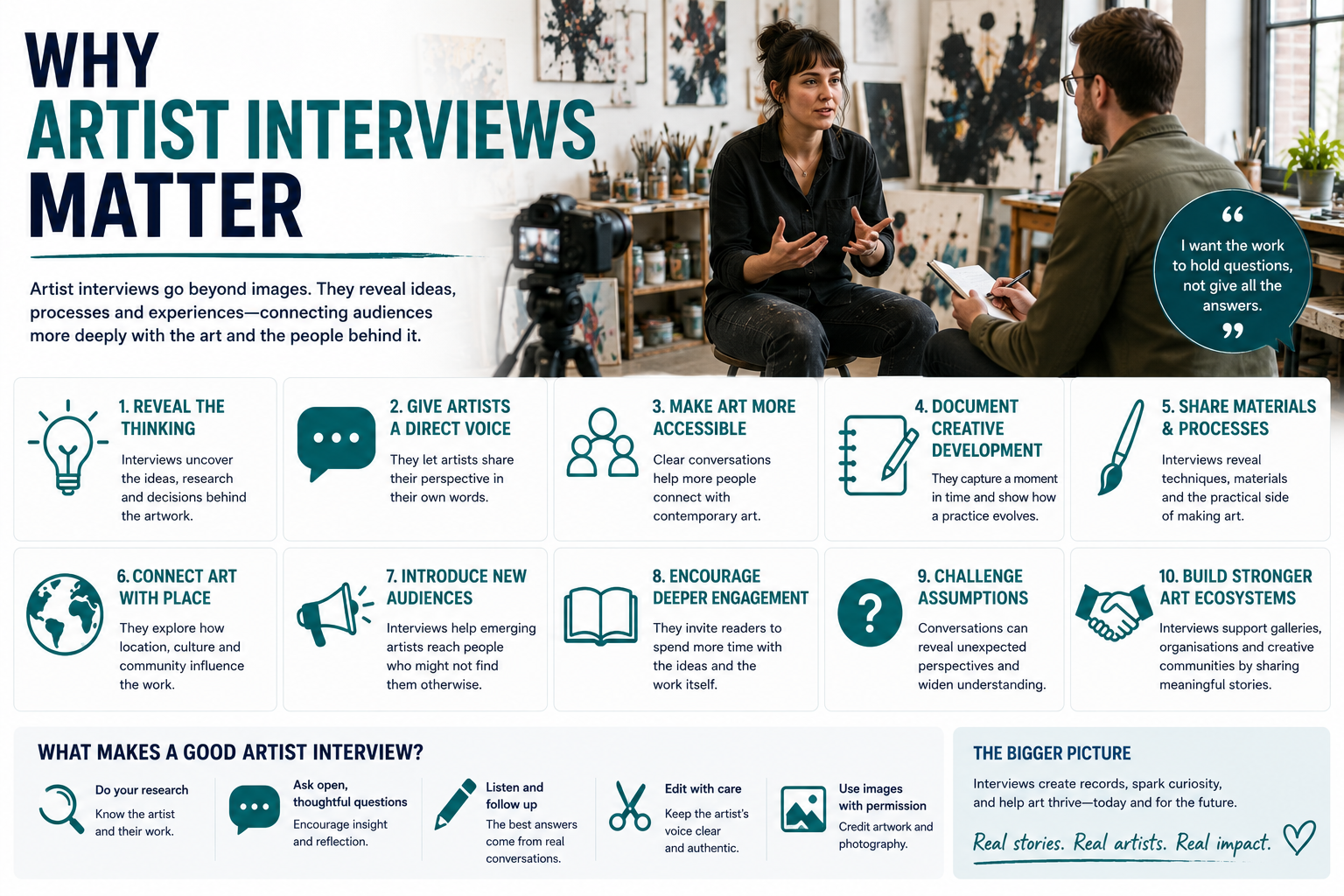
Artist interviews offer something that images alone cannot always provide: direct insight into how an artist thinks, works and develops ideas.
An artwork may invite interpretation, but an interview can reveal the decisions, experiences, materials and questions behind it. This can help audiences understand the practice more deeply without reducing the work to a single explanation.
Interviews can also give artists space to speak in their own words rather than being described entirely by critics, galleries or promotional materials.
For emerging artists in particular, a thoughtful interview can provide useful context, document an important stage in their career and introduce their work to new audiences.
They Reveal the Thinking Behind the Work
Viewers often encounter an artwork only after it has been completed and displayed.
They may not see:
- The initial sketches
- Failed experiments
- Research
- Material tests
- Changes in direction
- Practical challenges
- Long periods of uncertainty
An interview can uncover this process.
An artist may explain that a finished painting began with a photograph, a memory, a place, a political concern or an accidental mark made in the studio.
This does not tell the audience exactly how to interpret the work. Instead, it provides another layer of information.
The strongest interviews help readers understand where the work came from while still leaving room for personal response.
They Give Artists a Direct Voice
Artists are often discussed through:
- Gallery statements
- Reviews
- Exhibition texts
- Curatorial essays
- Press releases
- Social media posts
These forms can be useful, but they are usually written by someone else or shaped by a particular promotional purpose.
An interview allows the artist to explain:
- What matters to them
- What they are questioning
- How their practice has changed
- Which assumptions they reject
- How they describe their own work
This can be particularly important when an artist’s work relates to personal history, cultural identity, place, community or lived experience.
Direct responses can reduce the risk of the artist’s perspective being oversimplified.
They Make Contemporary Art More Accessible
Some audiences find contemporary art intimidating.
The language surrounding exhibitions can sometimes feel highly academic, abstract or difficult to understand.
A well-edited interview can make the work more approachable by asking clear questions such as:
- How did this series begin?
- Why did you choose this material?
- What happens during a typical studio day?
- What would you like viewers to notice?
- How has your work changed?
These questions help readers enter the conversation without requiring specialist knowledge.
Accessibility does not mean simplifying the artist’s ideas excessively. It means presenting them clearly enough for a wider audience to engage.
They Document Creative Development
An interview captures the artist at a specific moment.
It may document:
- A new body of work
- A first solo exhibition
- A residency
- A change of medium
- A new studio
- A major commission
- A shift in subject matter
- A period of uncertainty
Years later, the interview may become a useful record of how the practice developed.
Artists often reinterpret earlier work as their careers continue. An interview preserves what they were thinking at the time rather than relying only on later reflection.
This can be valuable to researchers, curators, collectors, students and the artists themselves.
They Show That Artistic Careers Are Not Linear
Artist biographies often make careers appear more organised than they really were.
A short biography may move neatly from education to exhibitions, awards and representation.
Interviews can reveal a more realistic picture.
Artists may discuss:
- Rejection
- Financial pressure
- Career breaks
- Changes in direction
- Unsuccessful applications
- Loss of confidence
- Family responsibilities
- Other employment
- Returning to art later in life
These experiences are often hidden from formal profiles.
Hearing about them can be especially helpful for emerging artists who may otherwise believe that professional development should follow a predictable path.
They Provide Insight Into Materials and Technique
Many viewers are interested in how artworks are made.
An interview can explain:
- Why a particular paint is used
- How a printing process works
- Where materials are sourced
- How digital and physical methods are combined
- How long a work takes
- Which tools are essential
- How scale affects the process
- How installation is planned
These details can deepen appreciation for the skill and decision-making involved.
Technical questions should not dominate every interview, but they can help audiences connect the final work with the labour behind it.
They Reveal the Role of Research
Artistic research may involve:
- Archives
- Scientific material
- Personal history
- Interviews
- Travel
- Literature
- Political events
- Local communities
- Historical documents
- Material experimentation
Much of this research may not be visible immediately in the finished artwork.
An interview can show how information is gathered and transformed.
The artist may use research directly, symbolically or only as a starting point.
Understanding this process can help audiences see the work as part of a wider investigation rather than an isolated object.
They Connect Art With Place
Many artists respond closely to the places where they live or work.
Interviews can explore:
- The studio environment
- Local history
- Landscape
- Architecture
- Community
- Migration
- Regional identity
- Urban change
- Environmental concerns
A studio visit interview may reveal how space influences scale, materials and working habits.
An artist working in a rural area may describe different opportunities and limitations from someone based in a large city.
This context can make the work more specific and grounded.
They Introduce Emerging Artists to New Audiences
Emerging artists may not yet have extensive press coverage, gallery representation or large online followings.
An interview can provide:
- A searchable introduction
- A professional profile
- Links to official work
- Context for an exhibition
- Useful quotations
- A record of current projects
This can help new audiences discover the artist through search engines, newsletters and social sharing.
The interview should remain editorially useful rather than reading like an advertisement.
Readers are more likely to engage with thoughtful questions and honest answers than with exaggerated praise.
They Help Galleries and Arts Organisations Tell Better Stories
Arts organisations often need to explain why an artist or exhibition matters.
Interviews can support:
- Exhibition promotion
- Public engagement
- Education
- Archive development
- Fundraising
- Community outreach
- Newsletter content
A gallery may use an interview to introduce a forthcoming exhibition.
A residency programme may document what an artist developed during their stay.
An arts charity may use interviews to show the wider value of studios, mentoring or community projects.
When done well, the interview becomes more than promotional content. It becomes part of the organisation’s cultural record.
They Encourage Slow Engagement
Online art content is often consumed quickly.
Images are scrolled past, liked and forgotten.
A longer interview encourages readers to spend more time with the artist’s ideas.
It may invite them to:
- Revisit the artwork
- Attend an exhibition
- Read further
- Watch a film
- Visit an open studio
- Follow the artist’s development
This slower engagement can be more meaningful than brief visibility.
It allows the artist’s practice to be understood as an ongoing body of work rather than a single striking image.
They Can Challenge Assumptions
Viewers may make assumptions based on:
- Style
- Materials
- Age
- Background
- Subject matter
- Location
- Previous exhibitions
An interview can complicate those assumptions.
A work that appears spontaneous may involve extensive planning.
A visually decorative piece may address difficult social issues.
A digital-looking image may have been made through physical processes.
An artist associated with one medium may be moving into another.
Good interviews create space for complexity rather than confirming the easiest interpretation.
What Makes an Artist Interview Effective?
A strong interview requires more than sending a generic list of questions.
The interviewer should first review:
- The artist’s website
- Previous exhibitions
- Current projects
- Available images
- Existing interviews
- Artist statements
- Relevant organisations
This makes it possible to ask questions that are specific to the artist.
Generic questions can still be useful, but they should be connected to the actual practice.
Ask Open Questions
Open questions encourage fuller answers.
Examples include:
- How did this body of work begin?
- What changed during the process?
- Which materials have become most important to you?
- How does your studio environment affect the work?
- What are you currently trying to understand?
- Has your relationship with the work changed since it was exhibited?
Questions that can be answered only with yes or no are usually less productive.
Avoid Overloading the Artist With Questions
A long questionnaire can lead to rushed or repetitive answers.
It is often better to ask a smaller number of thoughtful questions.
A useful structure may include:
- Background
- Current practice
- Materials or process
- Recent project
- Challenges
- Future direction
Follow-up questions can be added where necessary.
Let the Artist Explain Their Own Terms
Interviewers sometimes impose language that the artist would not use.
For example, they may describe the work as:
- Political
- Therapeutic
- Feminist
- Environmental
- Spiritual
- Autobiographical
These descriptions may be accurate, but the artist should be given an opportunity to define the work in their own way.
A better question might be:
Some viewers may read this work as political. How do you understand that aspect of it?
This allows the artist to agree, disagree or add nuance.
Include Specific Examples
General discussion becomes stronger when connected to a particular work, exhibition or project.
Instead of asking:
What inspires you?
Ask:
In your recent series, repeated architectural forms appear alongside figures. How did that visual language develop?
Specific questions show preparation and encourage more original responses.
Edit Carefully
Interview responses may need light editing for:
- Grammar
- Clarity
- Repetition
- Length
- Structure
However, editing should not change the meaning or make the artist sound unlike themselves.
The artist should ideally be given an opportunity to review factual details, particularly names, dates, titles and technical information.
The final piece should still feel like a conversation rather than a polished corporate statement.
Use Images With Permission
Artist interviews are usually stronger when accompanied by:
- Artwork images
- Studio photographs
- Installation views
- Portraits
- Process images
Permission should be obtained before publication.
Captions should include:
- Artist name
- Artwork title
- Year
- Materials
- Dimensions, where relevant
- Photographer credit
- Copyright information
Images should not be taken from social media or search engines without checking usage rights.
Link to Official Sources
An interview should help readers continue exploring.
Useful links include:
- Artist website
- Gallery profile
- Exhibition page
- Residency page
- Official social profile
- Relevant publication
- Organisation website
Links should lead to primary or reliable sources.
This supports the artist and gives readers access to accurate information.
Disclose Commercial Relationships
Some interviews are commissioned, sponsored or arranged through commercial partnerships.
This does not automatically make them unsuitable.
However, readers should be told when:
- The artist or gallery paid for the feature
- Travel or hospitality was provided
- The publication received another benefit
- The interview forms part of sponsored content
Transparency helps maintain trust.
The interview should still contain useful editorial substance.
Avoid Presenting Invented Interviews
An interview should be based on real responses from the named person.
Writers should not:
- Invent quotations
- Reconstruct answers without permission
- Present public statements as private responses
- Use AI to generate what the artist “might say”
- Combine several sources into a false interview
Where direct participation was not possible, the article should be described accurately as a profile, commentary or overview.
Interviews Are Not the Only Way to Understand Art
Artist interviews provide valuable context, but they should not be treated as the final authority on meaning.
Artists may not wish to explain everything.
They may also understand their work differently over time.
The viewer’s response remains important.
An interview works best when it opens possibilities rather than closes interpretation.
Final Thoughts
Artist interviews matter because they connect artworks with the people, processes and questions behind them.
They can make contemporary art more accessible, document creative development and give artists direct control over how their practices are discussed.
For emerging artists, interviews can also create a valuable public record and introduce their work to audiences who may not encounter it through galleries alone.
The strongest interviews are carefully researched, clearly edited and respectful of the artist’s voice. They do not explain the artwork away. They create another way to engage with it.