How to Compare Professional Service Providers Online
Choosing a professional service provider can be difficult when several businesses appear to offer similar expertise.
Whether someone is looking for an accountant, solicitor, consultant, marketing agency, architect, healthcare provider or property specialist, the decision often begins online. Potential clients may compare websites, reviews, qualifications, case studies, pricing and service descriptions before making contact.
A polished website can create a strong first impression, but it does not automatically prove that the provider is suitable.
The most reliable approach is to compare businesses using a consistent set of criteria and verify important claims before committing.
Start With the Exact Service You Need
Before comparing providers, define the problem you are trying to solve.
A broad search may produce businesses offering related but different services.
For example, a company searching for marketing support may need:
- Local SEO
- Paid advertising
- Website management
- Content creation
- Social media
- Strategic consultancy
These services require different skills.
A provider describing itself as a complete solution may not have equal expertise in every area.
Write down:
- The service required
- The main objective
- The available budget
- The preferred timeline
- Any location requirements
- Any professional or regulatory requirements
This makes it easier to compare relevant providers rather than every business appearing in the search results.
Review the Provider’s Positioning
A professional service provider should make its expertise clear.
The website should explain:
- What the business does
- Who it works with
- Which problems it addresses
- Where it operates
- How the service is delivered
Clear positioning can indicate that the provider understands its market.
For example, a specialist accountant for ecommerce businesses may be more appropriate than a general accountancy practice for a company dealing with complex online sales.
However, specialist positioning should still be supported by evidence.
Examine the Service Pages
Detailed service pages can reveal how well the provider understands the work.
Look for information about:
- What is included
- The process
- Typical stages
- Expected client involvement
- Timelines
- Deliverables
- Fees
- Limitations
- Next steps
Be cautious when service pages rely mainly on generic statements such as:
- Tailored solutions
- Exceptional service
- Industry-leading results
- A customer-first approach
These phrases may sound positive but provide little practical information.
A useful service page should help a potential client understand what they are actually buying.
Check Qualifications and Professional Registration
Some professional services require formal qualifications, licensing or registration.
Depending on the service, this may apply to:
- Solicitors
- Accountants
- Healthcare practitioners
- Architects
- Financial advisers
- Surveyors
- Engineers
- Certain trades
Check credentials directly with the relevant professional body where appropriate.
The website should clearly distinguish between:
- Formal qualifications
- Professional memberships
- Short training courses
- Industry certifications
- Awards
Not every badge or membership carries the same level of significance.
Look at Relevant Experience
Years in business can be useful, but relevant experience matters more.
Ask whether the provider has worked with:
- Similar organisations
- Similar project sizes
- Similar industries
- Similar budgets
- Similar technical requirements
- Similar locations
A provider may be highly experienced overall but unfamiliar with the specific type of work required.
Look for:
- Case studies
- Project examples
- Client sectors
- Named services
- Specific outcomes
The evidence should relate to the service being considered.
Read Case Studies Carefully
Case studies can be valuable, but they should be examined beyond the headline result.
A useful case study explains:
- The starting position
- The challenge
- The work completed
- The time involved
- The outcome
- Relevant limitations
Be cautious with claims such as:
- Traffic increased by 500%
- Revenue doubled
- Costs were dramatically reduced
- Results were achieved instantly
Ask what the original figures were and what other factors may have contributed.
A large percentage increase from a very small starting point may be less impressive than it first appears.
Compare Reviews Across Several Sources
Reviews can offer insight into the customer experience.
Look for repeated comments about:
- Communication
- Reliability
- Expertise
- Responsiveness
- Organisation
- Pricing
- Aftercare
- Problem resolution
Do not rely entirely on testimonials displayed on the provider’s own website.
Where possible, compare feedback from:
- Professional directories
- Industry platforms
- Independent review websites
- Social media
- Relevant publications
No business will satisfy every customer.
The important question is whether reviews reveal consistent strengths or recurring problems.
Consider the Quality of Review Responses
How a business responds to criticism can be revealing.
A professional response may:
- Acknowledge the concern
- Remain calm
- Explain the next step
- Protect confidential information
- Invite direct contact
Warning signs include:
- Aggressive language
- Blaming the customer publicly
- Revealing private information
- Copying the same response repeatedly
- Ignoring serious concerns
The response may reveal more about the business than the original complaint.
Check Independent Mentions
Relevant mentions on third-party websites can strengthen credibility.
These may include:
- Industry publications
- Professional associations
- Interviews
- Local news
- Business directories
- Award listings
- Conference programmes
- Specialist articles
The mention should be relevant and verifiable.
A large number of low-quality directory listings is less meaningful than a smaller number of credible industry references.
Review the Team
Professional services often depend on the people delivering the work.
Team profiles should ideally explain:
- Name
- Role
- Experience
- Qualifications
- Specialist areas
- Professional background
Ask whether the person shown during the sales process will also deliver the service.
In larger organisations, work may be completed by:
- Junior staff
- Account managers
- Contractors
- Outsourced specialists
- Overseas teams
This is not necessarily a problem, but responsibilities should be clear.
Understand the Delivery Model
Professional services may be delivered through:
- One-off projects
- Ongoing retainers
- Hourly support
- Fixed packages
- Subscriptions
- Consultations
- Managed services
Each model has advantages.
A fixed project can provide clearer boundaries, while an ongoing retainer may be more suitable for continuous work.
Ask:
- What is included?
- How many hours are available?
- How frequently is work completed?
- What happens when the allowance is exceeded?
- Can unused time be carried forward?
- Who approves additional work?
The service model should match the client’s needs.
Compare Pricing Properly
The cheapest provider is not always the best value, but the highest price does not guarantee quality.
Compare:
- Total cost
- Included work
- Number of hours
- Deliverables
- Meetings
- Revisions
- Software
- Reporting
- Travel
- Taxes
- Additional fees
A lower quotation may exclude tasks that another provider includes.
Where pricing is not published, ask how the fee is calculated.
Professional providers should be able to explain the basis of their charges.
Check Contract Terms
Before committing, review:
- Contract duration
- Notice period
- Renewal
- Payment schedule
- Late-payment terms
- Cancellation
- Ownership
- Confidentiality
- Data handling
- Dispute procedures
Long contracts are not automatically unreasonable, particularly when substantial setup work is required.
However, the term should be proportionate and clearly explained.
Avoid agreeing to terms you have not read.
Confirm Ownership of Important Assets
For services involving websites, marketing, technology or content, ownership should be clear.
The client should understand who controls:
- Domain names
- Hosting
- Websites
- Advertising accounts
- Analytics
- Business profiles
- Content
- Designs
- Customer data
- Software accounts
Important accounts should ideally be registered using client-controlled contact details.
A business should not become dependent on a supplier simply because the supplier holds all access credentials.
Ask How Success Is Measured
A provider should explain how progress will be evaluated.
Relevant measures may include:
- Enquiries
- Sales
- Revenue
- Cost savings
- Completion times
- Customer satisfaction
- Project milestones
- Search visibility
- Conversion rates
- Compliance
- Operational improvements
The measures should match the service.
Be cautious when reporting focuses only on activity.
For example, publishing ten articles is an output. It is not automatically evidence of improved business performance.
Understand the Reporting Process
Ask:
- How often reports are provided
- What they include
- Who explains them
- Whether raw data is accessible
- How recommendations are recorded
- How problems are escalated
Reporting should support decisions rather than create unnecessary paperwork.
A short, clear report can be more useful than a long document filled with metrics that are not connected to the client’s goals.
Review Communication Expectations
Communication should be agreed before work begins.
Clarify:
- Main contact
- Response times
- Meeting frequency
- Preferred communication channel
- Approval process
- Emergency procedures
- Availability
Some providers communicate through email, while others use project-management platforms, client portals or scheduled calls.
The arrangement should be practical for both sides.
Ask About Capacity
A provider may have relevant expertise but insufficient capacity.
Ask:
- When work can begin
- How many clients the team manages
- Who provides cover
- What happens during holidays
- How urgent work is handled
- Whether deadlines are guaranteed
A small provider may offer excellent personal service but have limited availability.
A larger firm may have more capacity but less direct contact with senior staff.
Neither model is automatically better.
Consider Cultural and Working Fit
The relationship may last months or years.
Practical fit matters.
Consider whether the provider:
- Communicates clearly
- Understands the organisation
- Respects deadlines
- Accepts feedback
- Explains recommendations
- Works at an appropriate pace
- Matches the desired level of formality
A highly capable provider may still be unsuitable if the working style creates constant frustration.
Be Cautious With Guarantees
Professional services involve variables that no provider can fully control.
Be cautious with promises such as:
- Guaranteed rankings
- Guaranteed legal outcomes
- Guaranteed investment returns
- Guaranteed health outcomes
- Guaranteed funding
- Guaranteed employment
- Guaranteed sales
A credible provider can explain expected opportunities, likely risks and realistic scenarios.
Certainty should not be promised where it does not exist.
Look for Transparency
Positive signs include:
- Clear pricing or pricing principles
- Named staff
- Detailed services
- Written processes
- Visible policies
- Realistic claims
- Transparent disclosures
- Verifiable credentials
Transparency does not mean every detail must be public.
It means that reasonable questions receive clear answers.
Warning Signs
Potential warning signs include:
- Pressure to decide immediately
- Refusal to provide written terms
- Vague deliverables
- Unclear credentials
- Guaranteed outcomes
- Poor communication
- No access to accounts
- Large upfront payments without explanation
- Repeated unresolved complaints
- No clear business details
- Unwillingness to provide references
One concern may have a reasonable explanation.
Several concerns should encourage further checks.
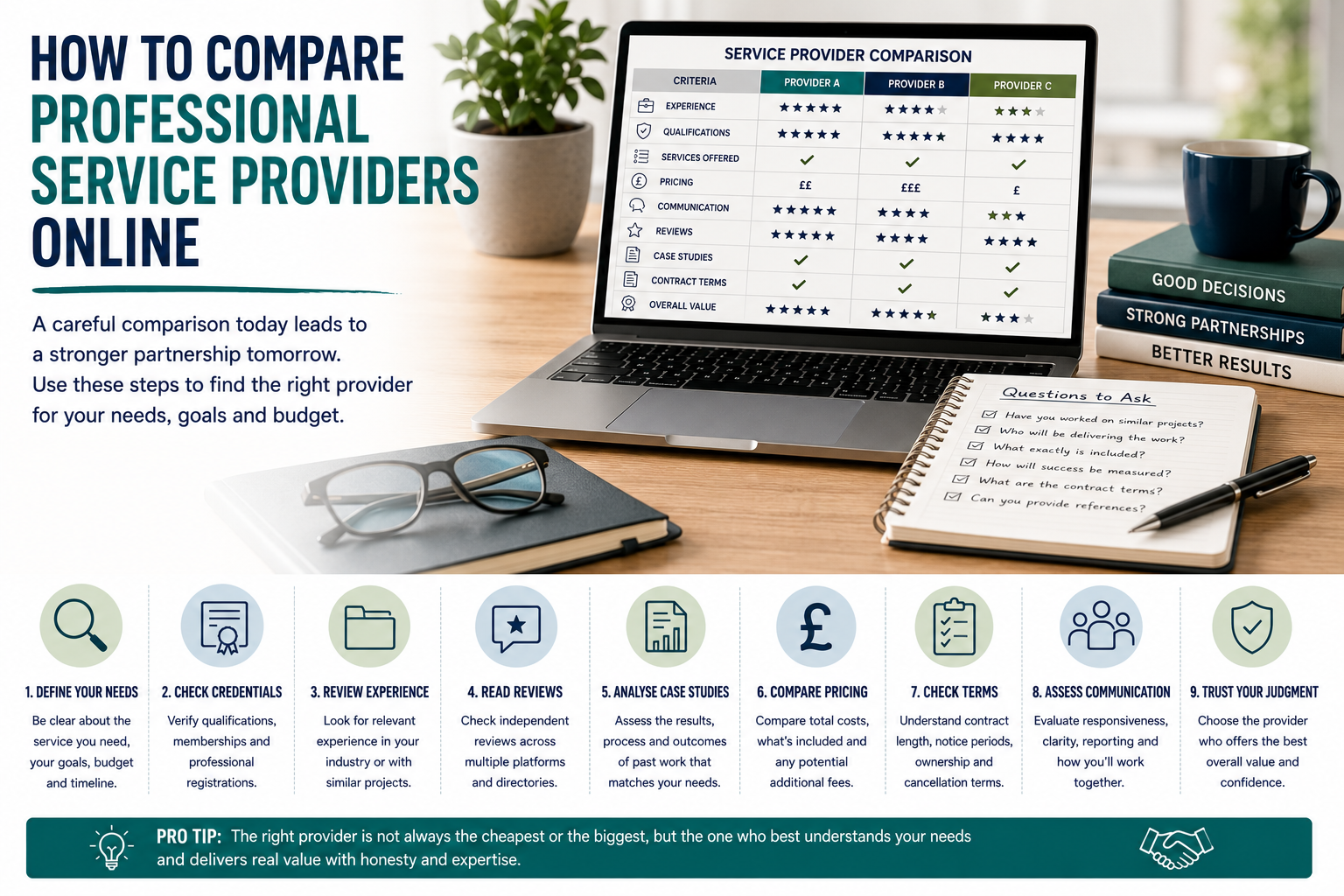
Create a Comparison Table
A simple comparison can make the decision easier.
| Factor | Provider A | Provider B | Provider C |
|---|---|---|---|
| Relevant experience | |||
| Qualifications | |||
| Service scope | |||
| Delivery model | |||
| Total price | |||
| Contract length | |||
| Main contact | |||
| Reporting | |||
| Reviews | |||
| Case studies | |||
| Ownership terms | |||
| Overall confidence |
Avoid choosing based on one factor alone.
Questions to Ask Before Hiring
Useful questions include:
- Have you worked on similar projects?
- Who will deliver the service?
- What exactly is included?
- What is excluded?
- How will progress be measured?
- How often will we communicate?
- What contract terms apply?
- Are any services outsourced?
- Who owns the completed work and accounts?
- What happens if the project is delayed?
- What additional costs may arise?
- Can you provide relevant references?
The quality of the answers can help reveal how the working relationship is likely to operate.
Final Thoughts
Comparing professional service providers online requires more than reviewing websites and prices.
Relevant experience, qualifications, service scope, communication, ownership, contract terms and independent evidence should all be considered.
The strongest provider is usually the one that combines appropriate expertise with clear expectations and transparent working practices.
Take time to verify important information, compare several options and ask questions before signing an agreement.
A careful selection process can reduce risk and create a stronger foundation for the work ahead.