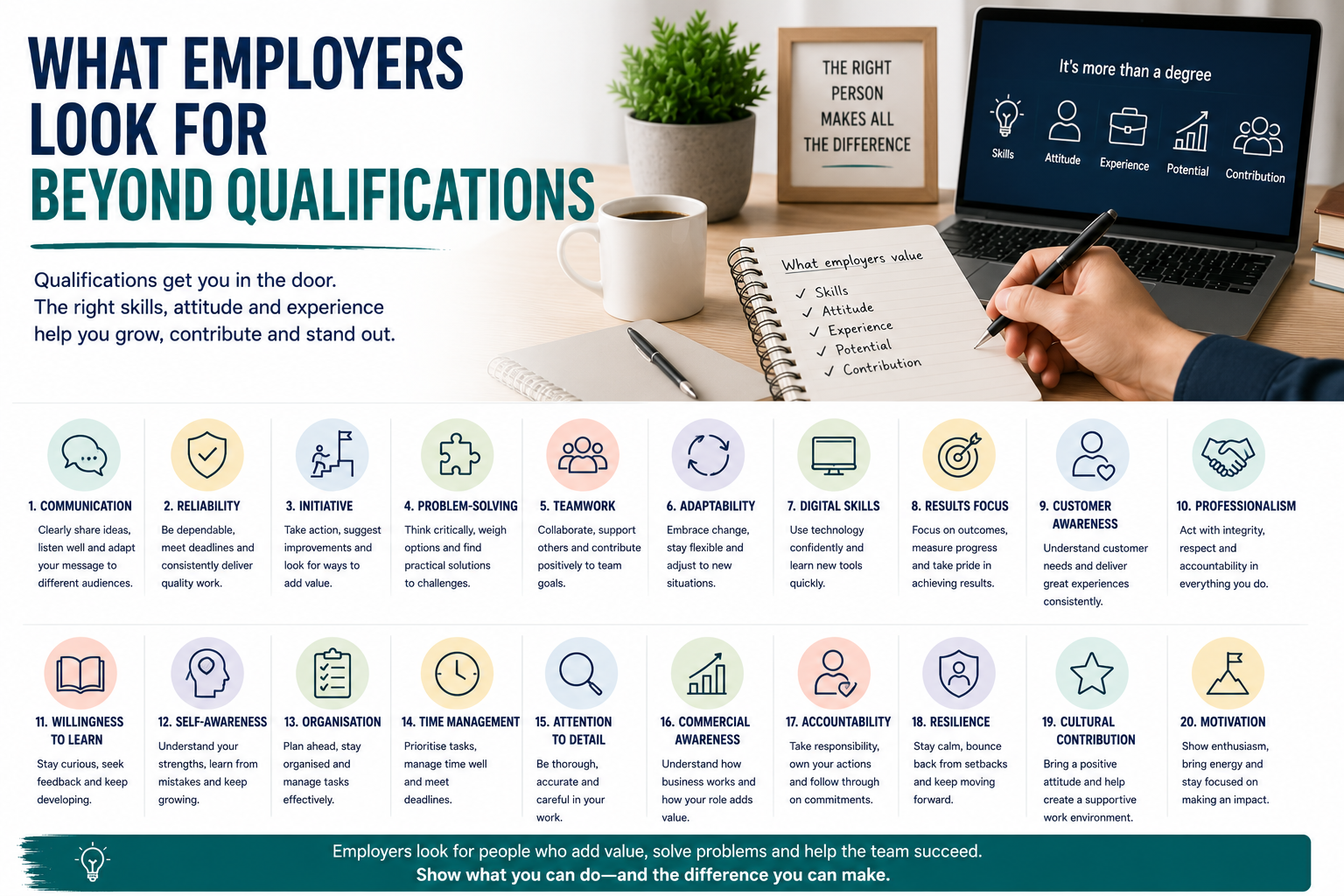
What Employers Look for Beyond Qualifications
Qualifications can help demonstrate subject knowledge, technical ability and commitment to learning.
However, employers rarely make hiring decisions based on certificates alone. Two candidates may hold similar qualifications but differ significantly in how they communicate, solve problems, work with others and respond to responsibility.
For many roles, employers are looking for evidence that a person can apply what they know in a practical setting.
The exact priorities vary between industries, but the following qualities often matter alongside formal education.
1. Clear Communication
Communication affects almost every workplace.
Employers may look for someone who can:
- Explain ideas clearly
- Listen carefully
- Ask relevant questions
- Write professional emails
- Speak appropriately with customers
- Share updates
- Raise concerns
- Adapt communication to different audiences
Strong communication does not mean speaking constantly or using complicated language.
It means helping other people understand what is happening, what is needed and what should happen next.
Candidates can demonstrate communication through:
- A clear CV
- Well-structured application answers
- Professional emails
- Thoughtful interview responses
- Relevant examples
- Concise explanations
Poor communication during recruitment may make an employer question how the candidate will communicate with colleagues or clients.
2. Reliability
Employers want people they can depend on.
Reliability may include:
- Arriving on time
- Meeting deadlines
- Following instructions
- Completing agreed work
- Responding when needed
- Giving advance notice of problems
- Maintaining consistent standards
A candidate can demonstrate reliability through examples from:
- Employment
- Volunteering
- Education
- Caring responsibilities
- Community projects
- Freelance work
- Personal projects
Reliability is especially important in smaller organisations, where one person’s delay can affect the wider team.
3. Initiative
Initiative means recognising when something needs attention and taking appropriate action.
Examples may include:
- Identifying a problem
- Suggesting an improvement
- Learning a new tool
- Helping a colleague
- Organising information
- Improving a process
- Following up without being reminded
Initiative should not be confused with ignoring instructions or making major decisions without authority.
Good initiative involves understanding the situation, acting responsibly and communicating clearly.
Employers often value candidates who can work independently without needing constant supervision.
4. Problem-Solving
Most jobs involve unexpected situations.
Employers may assess whether a candidate can:
- Identify the real problem
- Gather relevant information
- Consider options
- Make a sensible decision
- Ask for help when necessary
- Review the result
Strong problem-solving examples should explain:
- What happened
- Why it mattered
- What action was taken
- What the result was
- What was learned
The problem does not need to be dramatic.
A small example can still be effective if it shows clear judgement.
5. Teamwork
Many roles require people to work with colleagues who have different responsibilities, personalities and experience.
Employers may look for evidence that a candidate can:
- Share information
- Support colleagues
- Respect different perspectives
- Contribute fairly
- Handle disagreement
- Ask for input
- Accept feedback
- Work toward a shared goal
A good teamwork example should explain the candidate’s own contribution without taking credit for the entire group.
Employers may be cautious when someone describes every previous colleague as difficult.
This can suggest poor self-awareness or limited ability to work through normal workplace disagreements.
6. Adaptability
Workplaces change.
New software, processes, regulations, priorities and customer expectations may require employees to adjust.
Adaptability can involve:
- Learning a new system
- Changing responsibilities
- Working with different people
- Responding to feedback
- Managing an unexpected delay
- Adjusting to remote or hybrid work
- Reprioritising tasks
Employers are often looking for someone who can remain constructive during change.
This does not mean accepting every change without question. It means responding professionally and finding practical ways to continue working effectively.
7. Digital Skills
Most jobs now involve some level of digital work.
Depending on the role, employers may expect familiarity with:
- Documents
- Spreadsheets
- Video meetings
- Project-management systems
- Customer databases
- Online research
- Cloud storage
- Industry software
- Cybersecurity basics
Candidates do not need to know every system in advance.
More important may be the ability to learn unfamiliar tools.
It is useful to describe digital skills specifically.
Instead of writing:
Good computer skills
A candidate might write:
Confident using spreadsheets for tracking budgets, shared cloud documents for team collaboration and project-management software for deadlines.
Specific details are more credible.
8. Evidence of Results
Employers want to understand what a candidate has achieved.
A responsibility describes what someone was expected to do.
A result explains what happened because they did it well.
For example:
Responsibility:
Managed customer enquiries.
Result:
Managed customer enquiries and introduced a response template that reduced average reply times.
Useful results may include:
- Time saved
- Costs reduced
- Sales increased
- Errors prevented
- Processes improved
- Customers supported
- Projects completed
- Events organised
- Targets achieved
Results do not always need numbers, but measurable evidence can make an example stronger.
9. Customer Awareness
Even roles without direct sales responsibilities may affect the customer experience.
Employers may look for someone who understands:
- What customers need
- Why clear communication matters
- How delays affect people
- How complaints should be handled
- Why accurate information is important
- How their work contributes to service quality
Customer awareness can apply to:
- Retail
- Healthcare
- Education
- Professional services
- Trades
- Administration
- Technology
- Public services
Internal colleagues may also be considered customers of a process.
For example, an accounts assistant providing accurate information helps other departments work more effectively.
10. Professionalism
Professionalism is reflected in behaviour rather than job title.
It may include:
- Respectful communication
- Appropriate boundaries
- Confidentiality
- Honest reporting
- Suitable appearance
- Responsible use of social media
- Calm behaviour under pressure
- Following workplace policies
Professionalism does not mean being formal in every situation.
It means understanding what behaviour is appropriate for the role and environment.
During recruitment, professionalism may be assessed through:
- Punctuality
- Email tone
- Interview preparation
- Honesty
- Follow-up communication
- Treatment of reception or support staff
11. Willingness to Learn
Employers do not expect every candidate to know everything.
They may value someone who can:
- Accept feedback
- Ask thoughtful questions
- Learn from mistakes
- Complete training
- Seek better methods
- Keep skills current
- Recognise gaps in knowledge
A willingness to learn is particularly valuable in entry-level roles or industries that change quickly.
Candidates should avoid pretending to know something they do not.
An honest response such as:
I have not used that platform yet, but I have experience learning similar systems and would be comfortable training on it.
This can be stronger than bluffing.
12. Self-Awareness
Self-awareness means understanding your strengths, limitations and working style.
Employers may look for candidates who can reflect on:
- What they do well
- Where they need support
- How they respond to pressure
- How they receive feedback
- What motivates them
- What they have learned from mistakes
A strong answer to a question about weakness should be honest but constructive.
For example:
I used to spend too long perfecting minor details, so I now agree priorities and deadlines at the start of a task.
This shows both awareness and action.
13. Organisation
Organisation helps people manage competing responsibilities.
Employers may look for evidence of:
- Prioritising tasks
- Meeting deadlines
- Maintaining records
- Planning ahead
- Managing calendars
- Tracking progress
- Following procedures
Good organisation does not require a complex system.
It may involve:
- A task list
- A calendar
- Project software
- Checklists
- Clear folders
- Regular reviews
Candidates should explain how they organise work rather than simply claiming to be organised.
14. Time Management
Time management is closely connected to organisation, but it focuses more specifically on using available time effectively.
Useful examples may include:
- Balancing several deadlines
- Planning a busy shift
- Managing study and work
- Scheduling customer appointments
- Completing a project in stages
- Adjusting priorities during an urgent request
Employers understand that delays sometimes happen.
The key question is whether the candidate communicates early and manages the situation responsibly.
15. Attention to Detail
Some roles require a high level of accuracy.
This may involve:
- Checking figures
- Reviewing documents
- Following safety procedures
- Recording customer details
- Checking orders
- Testing work
- Proofreading
- Maintaining compliance
Candidates can demonstrate attention to detail by describing how they reduce mistakes.
For example:
- Using checklists
- Reviewing work twice
- Comparing against source information
- Asking another person to verify critical details
- Following a standard process
The strongest examples show a method rather than a general claim.
16. Commercial Awareness
Commercial awareness means understanding how the organisation operates and what affects its success.
This can include awareness of:
- Customers
- Costs
- Competitors
- Revenue
- Efficiency
- Reputation
- Industry trends
- Regulation
- Market demand
Candidates do not need to be financial experts.
However, they should understand that their work has consequences.
For example:
- Delayed invoicing affects cash flow
- Poor communication affects retention
- Waste affects profitability
- Errors affect reputation
- Missed deadlines affect customers
Researching the employer before an interview can demonstrate commercial awareness.
17. Accountability
Accountability means taking responsibility for your work.
Employers may value people who can:
- Admit mistakes
- Correct problems
- Keep others informed
- Avoid blaming colleagues
- Learn from feedback
- Follow through on commitments
A useful interview example might explain a mistake, how it was addressed and what changed afterwards.
Trying to appear completely faultless can be less credible than showing responsible reflection.
18. Resilience
Resilience is the ability to continue functioning constructively when work becomes difficult.
It may involve:
- Responding to rejection
- Managing pressure
- Recovering from a mistake
- Handling a demanding period
- Adjusting after a setback
- Maintaining perspective
Resilience does not mean tolerating unhealthy or unsafe conditions.
It means being able to respond to normal workplace challenges without becoming unable to act.
Employers should also create reasonable environments rather than expecting individuals to absorb unlimited pressure.
19. Cultural Contribution
Employers may consider how a person will contribute to the working environment.
This may include:
- Respect
- Collaboration
- Inclusivity
- Openness
- Constructive communication
- Shared responsibility
- Willingness to support others
“Culture fit” should not mean hiring people who all think, speak or behave in the same way.
A healthier approach is to consider whether someone can contribute positively while bringing a different perspective.
20. Motivation
Employers may ask why a candidate wants the role.
A strong answer should connect:
- The role
- The organisation
- The candidate’s experience
- The candidate’s development goals
Weak answers may sound generic:
I have always wanted to work for a successful company.
A stronger answer might explain:
The role combines customer communication and project coordination, which are the areas I have most enjoyed in my previous work.
Motivation should feel specific and believable.
How Employers Assess These Qualities
Employers may evaluate skills beyond qualifications through:
- Application forms
- CV examples
- Interviews
- Work samples
- Tests
- Presentations
- Trial tasks
- References
- Assessment centres
Candidates should prepare real examples in advance.
A useful structure is:
- Situation
- Task
- Action
- Result
This helps keep answers focused.
How to Show Transferable Skills
Not every candidate has direct experience in the exact role.
Transferable skills may come from:
- Part-time work
- Volunteering
- Education
- Freelance projects
- Caring responsibilities
- Community groups
- Personal projects
- Hobbies
For example, organising a community event may demonstrate:
- Planning
- Communication
- Budgeting
- Teamwork
- Problem-solving
- Time management
The candidate should explain how the experience relates to the role.
Avoid Listing Skills Without Evidence
A CV may include words such as:
- Motivated
- Organised
- Reliable
- Creative
- Hard-working
- Team player
These claims are common and difficult to verify.
They become more convincing when supported by examples.
Instead of:
Excellent organisational skills
Write:
Coordinated weekly schedules for a five-person team and maintained project records across twelve active accounts.
Evidence gives the employer something concrete to assess.
Tailor Applications to the Role
Different jobs prioritise different qualities.
A customer-service role may place greater emphasis on:
- Communication
- Empathy
- Calmness
- Problem-solving
A technical role may prioritise:
- Accuracy
- Analysis
- Digital skills
- Documentation
A management role may require:
- Leadership
- Delegation
- Decision-making
- Accountability
Read the job description carefully and use examples that match the stated requirements.
Research the Employer
Before applying or attending an interview, review:
- The organisation’s website
- Services
- Customers
- Values
- Recent news
- Sector
- Competitors
- Current priorities
This helps candidates explain why they are interested and how they may contribute.
It also allows them to ask more thoughtful questions.
Questions Candidates Can Ask
Useful interview questions may include:
- What would success look like in the first three months?
- Which skills matter most in this role?
- How is performance measured?
- What training is provided?
- How does the team work together?
- What are the main current challenges?
- What progression opportunities exist?
Good questions show interest in the actual work rather than only the benefits.
Final Thoughts
Qualifications can open the door to an opportunity, but employers often make decisions based on a wider combination of skills, behaviour and evidence.
Communication, reliability, initiative, teamwork, adaptability and problem-solving can be just as important as formal education.
Candidates should focus on showing how they have applied these qualities in real situations.
The strongest applications do not simply list strengths. They provide clear examples of what the candidate did, why it mattered and what happened as a result.