What to Look for in a Rehabilitation Clinic
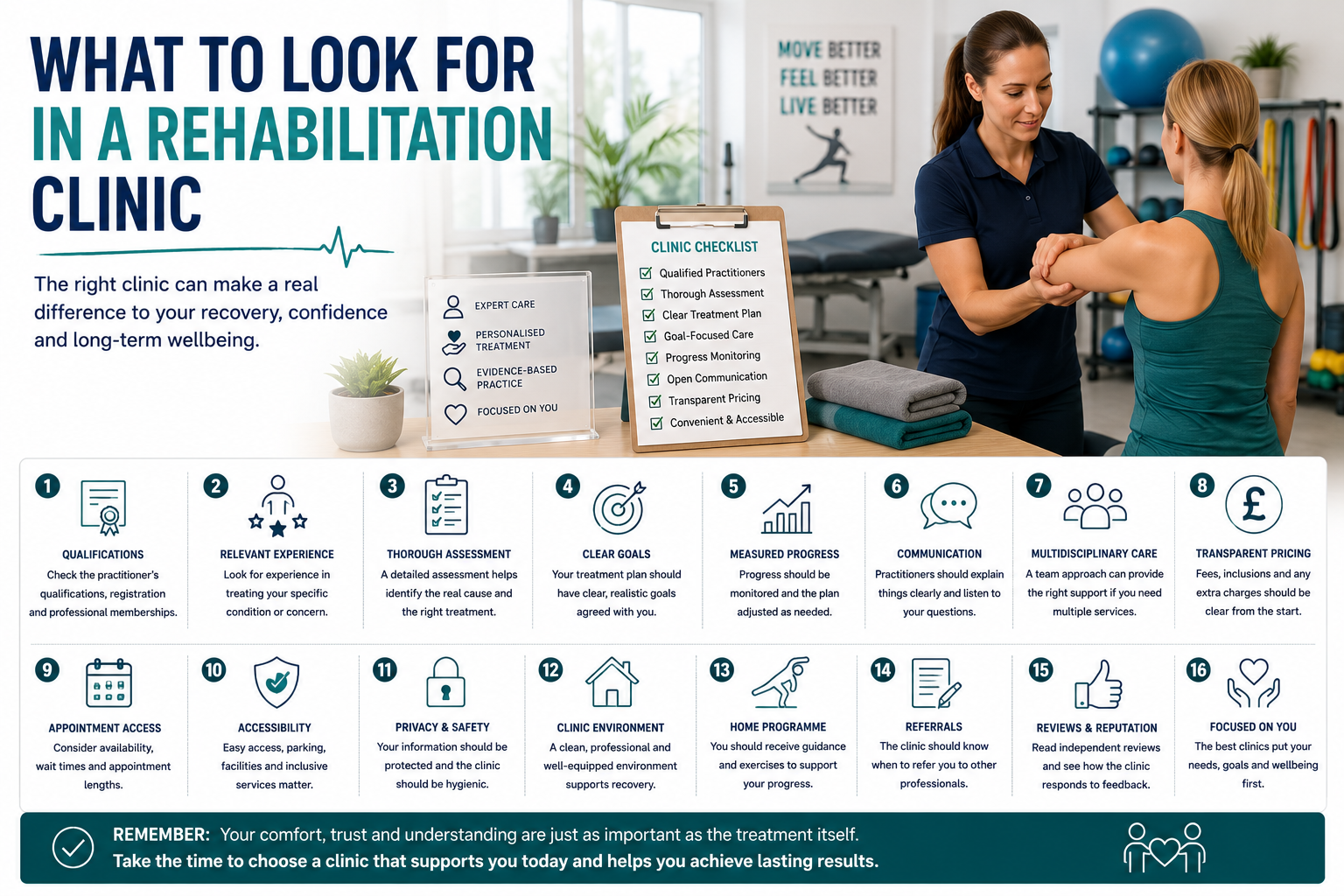
Choosing a rehabilitation clinic can influence how clearly a condition is assessed, how well treatment is explained and how confident a patient feels throughout the process.
Some clinics focus on one profession, while others offer several rehabilitation services under one roof. The most suitable option depends on the patient’s needs, the practitioner’s qualifications, the clinic’s approach and practical factors such as location, fees and appointment availability.
A professional website and modern premises can create a good first impression, but they do not provide a complete picture.
The following considerations can help patients compare rehabilitation clinics more carefully.
Start With the Type of Support You Need
Rehabilitation can involve many different services.
These may include:
- Physiotherapy
- Chiropractic care
- Occupational therapy
- Registered massage therapy
- Acupuncture
- Sports rehabilitation
- Post-operative rehabilitation
- Neurological rehabilitation
- Return-to-work support
- Pain-management services
The first step is to identify which type of professional may be appropriate.
This is not always obvious.
A patient may begin by speaking with:
- A GP
- A specialist
- A regulated rehabilitation professional
- An insurer
- A workplace health provider
For urgent, severe or unexplained symptoms, medical assessment may be more appropriate than booking routine rehabilitation directly.
Check Practitioner Qualifications
Practitioner qualifications should be easy to find.
A clinic should ideally provide:
- Practitioner names
- Professional titles
- Qualifications
- Areas of practice
- Registration details
- Relevant professional memberships
The requirements differ by profession and location.
Some professional titles are legally protected, while others are not.
Patients should verify registration directly with the relevant regulator where necessary.
A logo or membership badge should not be accepted automatically as proof of professional status.
Look for Relevant Experience
General experience is useful, but experience related to the patient’s needs may be more important.
A practitioner may work mainly with:
- Sports injuries
- Post-operative recovery
- Persistent pain
- Workplace injuries
- Older adults
- Neurological conditions
- Mobility problems
- Repetitive strain
- Return to activity
The clinic website may provide information about common areas of practice.
Patients can also ask:
- Do you regularly work with this type of concern?
- Which practitioner would be most appropriate?
- Would another professional need to be involved?
- Is a medical referral recommended first?
A responsible clinic should recognise when a concern falls outside its expertise.
Understand the Initial Assessment
The first appointment should involve more than a quick introduction.
Depending on the practitioner and concern, an assessment may include:
- Medical history
- Current symptoms
- Previous treatment
- Daily activities
- Work demands
- Movement
- Strength
- Mobility
- Functional testing
- Rehabilitation goals
The clinic should explain:
- How long the first appointment lasts
- What the patient should bring
- What clothing may be suitable
- Whether treatment may begin immediately
- Whether reports or imaging are required
- Whether a referral is necessary
A careful assessment helps the practitioner decide what support may be appropriate.
Look for Clear Explanations
Patients should understand what is being recommended and why.
A practitioner should be able to explain:
- What has been assessed
- What findings are relevant
- What the options are
- What the proposed treatment involves
- Possible benefits
- Relevant risks
- Expected review points
- Alternatives
Technical language should be explained clearly.
Patients should not feel pressured to agree to treatment they do not understand.
Check How Goals Are Set
Rehabilitation should usually connect to practical goals.
These may include:
- Walking more comfortably
- Returning to work
- Using stairs
- Sleeping better
- Lifting
- Driving
- Returning to sport
- Improving balance
- Managing daily activities
- Increasing confidence with movement
Goals should be realistic and relevant to the patient.
A good clinic may ask:
- What are you currently unable to do?
- What activity matters most to you?
- What would meaningful progress look like?
- What would you like to return to?
The plan should be reviewed as circumstances change.
Ask How Progress Is Measured
Progress should be assessed using more than vague impressions.
Depending on the situation, the clinic may monitor:
- Pain
- Strength
- Range of motion
- Walking distance
- Balance
- Work tolerance
- Sleep
- Functional tasks
- Exercise capacity
- Confidence
The practitioner should explain when progress will be reviewed.
If there is limited improvement, the plan may need to change.
This could involve:
- Adjusting treatment
- Revisiting the assessment
- Changing appointment frequency
- Referring to another professional
- Seeking medical input
Review the Treatment Approach
Different clinics may use different approaches.
These may include:
- Exercise-based rehabilitation
- Manual therapy
- Education
- Movement retraining
- Activity modification
- Home programmes
- Workplace advice
- Self-management strategies
Patients should ask how the clinic balances in-clinic treatment with activities completed independently.
A rehabilitation plan should not necessarily depend on indefinite appointments.
The patient should understand how each part of the plan supports the agreed goals.
Check Whether Care Is Individualised
A clinic may use standard procedures, but treatment should still reflect the individual patient.
Care may need to consider:
- Age
- General health
- Work
- Activity level
- Previous injuries
- Medication
- Personal goals
- Time constraints
- Financial limits
- Other healthcare
Be cautious when every patient appears to receive the same programme without a clear explanation.
Consider Multidisciplinary Care
Some clinics bring together several professions.
This may make it easier to coordinate support when more than one type of input is needed.
Potential benefits include:
- Internal referrals
- Shared information
- Coordinated goals
- Easier communication
- Access to several services
However, patients should not be encouraged to use multiple services simply because they are available.
Ask:
- Why is another practitioner being recommended?
- What will that service add?
- How will information be shared?
- Who is coordinating the plan?
- Are services billed separately?
The purpose of multidisciplinary care should be clear.
Look at Appointment Length
Appointment length may vary between clinics.
Longer appointments are not automatically better, but the time should be sufficient for:
- Assessment
- Explanation
- Questions
- Treatment
- Exercise instruction
- Documentation
Ask whether the initial appointment is longer than follow-up visits.
Also check whether late arrival reduces the session time.
Review Fees
Fees should be explained clearly before booking.
Check:
- Initial assessment cost
- Follow-up cost
- Treatment duration
- Additional fees
- Report charges
- Form-completion fees
- Insurance billing
- Cancellation fees
- Late-arrival policies
Patients should understand whether treatment is included in the first appointment.
Where insurance is involved, confirm coverage directly with the insurer.
A service may be eligible for reimbursement without being fully covered.
Be Cautious With Large Prepaid Packages
Some clinics offer treatment packages.
These may provide convenience or reduced pricing, but patients should understand:
- Number of appointments
- Expiry dates
- Refund terms
- Transfer rules
- Cancellation
- Clinical justification
- What happens if treatment is no longer needed
Patients should be cautious when pressured to purchase a large package before a proper assessment has been completed.
The number of appointments required cannot always be predicted precisely at the first visit.
Check the Cancellation Policy
Cancellation policies help clinics manage appointment time.
Before booking, check:
- Notice required
- Cancellation fee
- Missed-appointment fee
- Rescheduling rules
- Exceptional circumstances
- Insurance implications
The policy should be visible and clearly communicated.
Consider Appointment Availability
Rehabilitation may require several appointments.
Practical availability matters.
Check:
- Opening hours
- Evening appointments
- Weekend appointments
- Online booking
- Waiting times
- Practitioner availability
- Same-day support
- Follow-up scheduling
A highly suitable practitioner may still be difficult to use if appointments are rarely available.
Review Accessibility
Patients should consider whether the clinic is physically and practically accessible.
Questions may include:
- Is there step-free access?
- Is there a lift?
- Are accessible toilets available?
- Is parking nearby?
- Is public transport convenient?
- Can a support person attend?
- Are interpreters available?
- Are virtual appointments offered?
The clinic should provide clear accessibility information.
Check the Environment
The clinic should appear:
- Clean
- Organised
- Safe
- Private
- Appropriate for the services provided
Patients should feel comfortable raising concerns about:
- Hygiene
- Privacy
- Equipment
- Safety
- Noise
- Waiting areas
A modern interior is not necessary, but the environment should support professional care.
Consider Privacy
Health information should be handled carefully.
The clinic should explain:
- How records are stored
- Who can access them
- How information is shared
- How consent is recorded
- How long records are retained
- How online forms are protected
If several practitioners work in the clinic, patients should understand whether records are shared automatically.
Consent requirements may vary by location and situation.
Read Reviews Carefully
Reviews can provide insight into:
- Communication
- Organisation
- Cleanliness
- Appointment management
- Staff behaviour
- Overall patient experience
However, reviews should not be treated as medical evidence.
One person’s result does not predict another’s.
Be cautious of reviews or marketing claims describing:
- Guaranteed recovery
- Permanent cures
- Instant results
- Treatment suitable for everyone
A responsible clinic should acknowledge that outcomes vary.
Check How the Clinic Responds to Criticism
Review responses can show how the clinic handles concerns.
A professional response may:
- Remain respectful
- Avoid revealing confidential information
- Invite private discussion
- Explain the complaints process
- Acknowledge the concern
A clinic should never disclose a patient’s private health details publicly.
Look for Realistic Claims
Healthcare marketing should be careful and accurate.
Warning signs may include:
- Guaranteed outcomes
- Claims to treat every condition
- Suggestions that one service replaces all medical care
- Pressure to avoid other professionals
- Unsupported superlatives
- Fear-based messaging
Positive signs include:
- Clear limitations
- Appropriate disclaimers
- Evidence-based information
- Willingness to refer elsewhere
- Balanced explanations
Ask About Referrals
A rehabilitation clinic should know when external input may be needed.
Patients may require referral to:
- A GP
- A specialist
- Imaging
- Emergency care
- Another rehabilitation profession
- Mental health support
- Occupational health
Ask how the clinic handles concerns outside its scope.
Review Home Exercise Support
Many rehabilitation plans include exercises or activities between appointments.
The clinic should provide clear guidance on:
- What to do
- How often
- How many repetitions
- What discomfort may be acceptable
- When to stop
- How to ask questions
- How progress will be reviewed
Written instructions, diagrams or videos may help.
The patient should understand the programme before leaving.
Check Whether the Clinic Supports Self-Management
Good rehabilitation often helps patients become more confident managing their condition.
Support may include:
- Education
- Activity planning
- Exercise
- Pacing
- Prevention
- Return-to-work guidance
- Return-to-sport planning
- Recognition of warning signs
Patients should not become dependent on appointments without a clear clinical reason.
Questions to Ask Before Booking
Useful questions include:
- Which practitioner should I see?
- What qualifications and registration do they hold?
- Do they work with this type of concern?
- What happens during the first appointment?
- How long is the appointment?
- What does it cost?
- Is treatment included?
- How is progress measured?
- Will I receive exercises?
- Is insurance direct billing available?
- What is the cancellation policy?
- When would you refer me elsewhere?
The clinic should be able to answer these questions clearly.
Warning Signs
Potential warning signs include:
- Unclear qualifications
- Guaranteed recovery
- Large prepaid packages
- No explanation of the plan
- Pressure to continue indefinitely
- Poor privacy
- Unclear fees
- No referral process
- Treatment outside professional scope
- Refusal to answer questions
One concern may have an explanation, but several should encourage caution.
Preparing for the First Appointment
Patients can prepare by bringing:
- Symptom notes
- Medication list
- Relevant reports
- Imaging results
- Insurance information
- Referral documents
- Questions
- Suitable clothing
- Relevant footwear or equipment
Think about how the problem affects everyday life.
Specific examples can help the practitioner understand the impact more clearly.
Final Thoughts
Choosing a rehabilitation clinic involves more than finding the nearest provider.
Practitioner qualifications, relevant experience, assessment quality, communication, fees, accessibility and realistic claims should all be considered.
Patients should understand the purpose of the proposed plan, how progress will be measured and when other professional input may be needed.
A good rehabilitation clinic should help patients feel informed, respected and actively involved in decisions.
For urgent, severe or rapidly worsening symptoms, contact an appropriate medical professional or emergency service rather than relying on general online guidance.