How to Get More From an Open Studio Visit
Open studios give visitors a chance to see where artists work, discover new creative practices and speak directly with the people behind the artwork.
Unlike a formal gallery exhibition, an open studio may include finished work, experiments, materials, sketchbooks and projects that are still developing. This can make the experience more informal, personal and revealing.
For someone unfamiliar with contemporary art, walking into an artist’s workspace may initially feel intimidating. However, visitors do not need specialist knowledge or a collecting budget to enjoy the event.
A little preparation and curiosity can make an open studio visit far more rewarding.
Understand What an Open Studio Is
An open studio is an event where artists invite members of the public into their working spaces.
It may take place in:
- A shared studio building
- An artist’s private workspace
- A converted factory
- A community arts centre
- A print workshop
- A residency
- A gallery with working studios
- A temporary project space
Some events feature one artist, while others involve dozens of studios across a building or local area.
Visitors may encounter:
- Painting
- Drawing
- Sculpture
- Printmaking
- Photography
- Ceramics
- Textiles
- Installation
- Digital work
- Film
- Mixed media
The atmosphere is usually less formal than a gallery opening.
The event is designed to allow conversation, discovery and direct engagement with creative work.
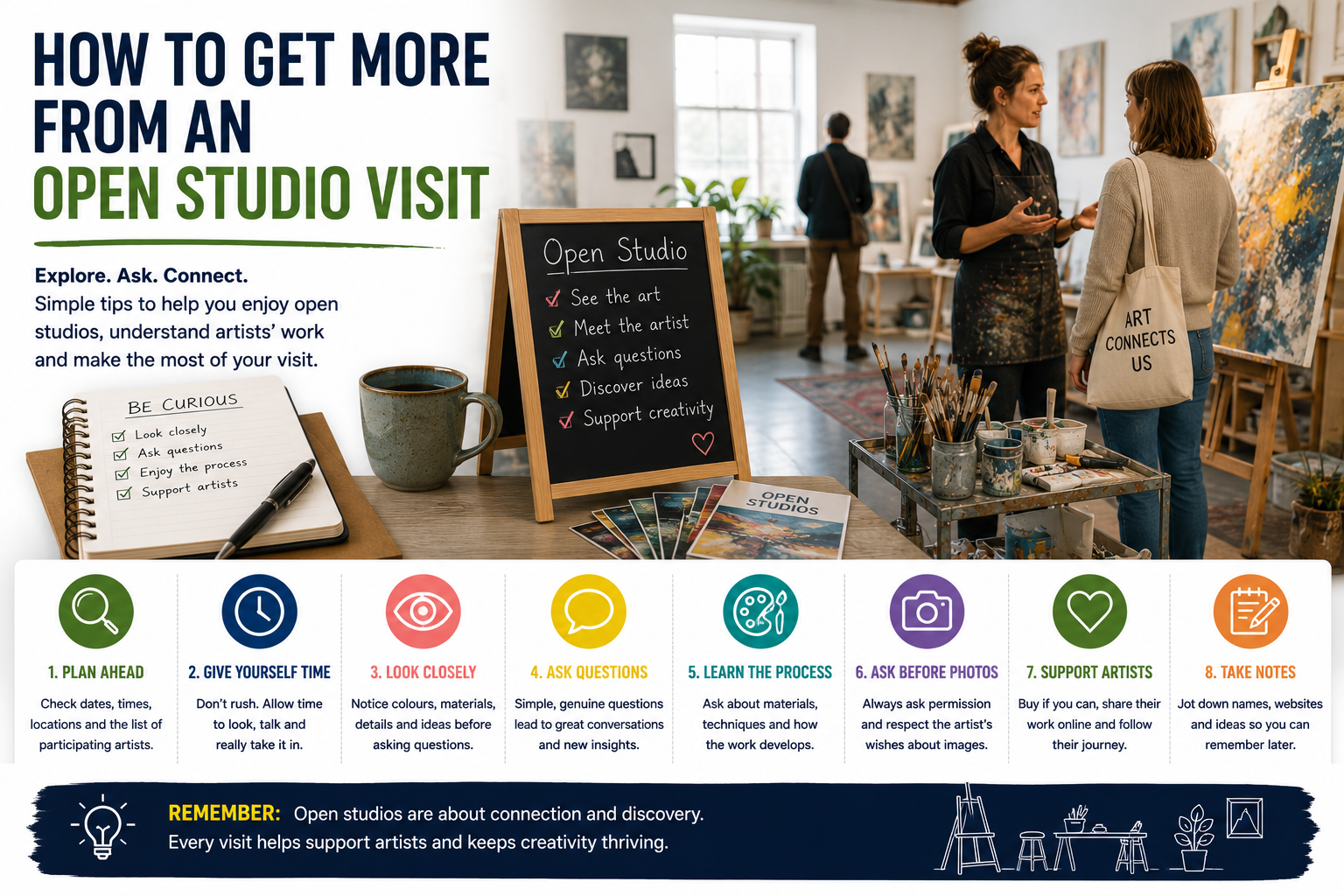
Check the Event Information Before You Go
Open studio events vary considerably.
Before travelling, check:
- Date
- Opening hours
- Address
- Public transport
- Parking
- Accessibility
- Participating artists
- Building layout
- Refreshments
- Entry cost
- Booking requirements
Some events are spread across several buildings or locations.
Others may include:
- Artist talks
- Demonstrations
- Workshops
- Performances
- Guided tours
- Family activities
Reviewing the programme can help you decide how much time to allow.
Give Yourself Enough Time
Open studios are difficult to appreciate when rushed.
A large event may require several hours, particularly if you want to speak with artists.
Avoid trying to see every studio in a few minutes.
It may be more rewarding to visit fewer spaces thoughtfully than to move quickly through the entire building.
Allow time to:
- Look carefully
- Read information
- Ask questions
- Explore different rooms
- Return to work that interests you
- Take breaks
Creative events can become visually overwhelming, so a short pause may help you remain attentive.
Begin With Curiosity Rather Than Judgement
You do not need to decide immediately whether you like a piece of work.
Start by asking:
- What am I looking at?
- Which materials were used?
- What details attract my attention?
- Does the work remind me of anything?
- How does it make me feel?
- What questions does it raise?
Some artwork communicates immediately.
Other work becomes more interesting after learning about its context or process.
An open studio offers the opportunity to look beyond first impressions.
Spend Time With the Work Before Asking Questions
It is often helpful to look carefully before beginning a conversation.
Notice:
- Colour
- Scale
- Texture
- Repeated forms
- Materials
- Subject matter
- Presentation
- Differences between works
This gives you something specific to discuss.
Instead of asking only:
What is this about?
You might ask:
I noticed the same shape appears in several works. How did that develop?
Specific questions often lead to more interesting conversations.
Do Not Worry About Asking the “Wrong” Question
Artists generally understand that visitors have different levels of experience.
You do not need to use specialist language.
Simple questions can be effective:
- How did you begin this series?
- What materials are you using?
- How long have you worked in this studio?
- What are you currently exploring?
- Which part of the process do you enjoy most?
- Is this work part of a larger project?
- What are you working on next?
A genuine question is usually better than trying to sound knowledgeable.
Ask About the Creative Process
The studio environment can reveal how artwork is produced.
You may see:
- Brushes
- Printing plates
- Tools
- Clay
- Fabric
- Photographs
- Research notes
- Sketches
- Digital equipment
- Material samples
Ask how these elements are used.
Possible questions include:
- Do you plan the work in advance?
- Does the piece change while you make it?
- How do you decide when it is finished?
- Have you always used this material?
- What happens when an experiment fails?
- How long does a typical work take?
Process questions can help connect the finished artwork with the decisions behind it.
Look at Works in Progress
Finished pieces often receive the most attention, but works in progress can be especially informative.
They may reveal:
- Underpainting
- Construction methods
- Changes in composition
- Material tests
- Abandoned ideas
- Revisions
- Early stages
Ask whether the artist is comfortable discussing unfinished work.
Some artists enjoy showing the process, while others prefer to keep developing work private.
Respect their preference.
Notice the Studio Environment
The studio itself can affect the work.
Consider:
- Size
- Light
- Storage
- Tools
- Surfaces
- Organisation
- Shared facilities
- Location
A printmaker may depend on access to a press.
A sculptor may need large floor space and specialist ventilation.
A painter may organise work around natural light.
The studio can help explain practical choices in the artist’s practice.
Read the Artist’s Information
Many artists provide:
- Statements
- Biographies
- Price lists
- Exhibition details
- Business cards
- Catalogues
- Postcards
- Website links
- QR codes
These materials can help you remember the artist later.
An artist statement may provide useful context, but do not worry if every idea is not immediately clear.
You can ask the artist to explain a particular phrase or theme.
Avoid Dominating the Artist’s Time
Artists often want to speak with visitors, but open studios can become busy.
Be aware when:
- Other visitors are waiting
- The artist is involved in another conversation
- A demonstration is about to begin
- The space is crowded
A short, thoughtful conversation may be more appropriate than a long discussion during a busy period.
You can often follow up later by email or through the artist’s website.
Respect Personal and Working Areas
A studio is a workplace, not only an exhibition space.
Some areas may contain:
- Fragile materials
- Sharp tools
- Chemicals
- Unfinished work
- Personal belongings
- Confidential notes
- Valuable equipment
Do not enter restricted areas or handle objects without permission.
Follow signs and instructions.
Children should be supervised closely where tools or delicate work are present.
Ask Before Taking Photographs
Photography policies vary.
Before photographing:
- Artwork
- The artist
- Sketchbooks
- The studio
- Works in progress
Ask for permission.
Some artists may allow general photographs but not close-up images of unfinished work.
Others may request:
- Artist credit
- No flash
- No commercial use
- No filming
- No social posting
Respect the artist’s decision.
Credit Artists When Sharing Online
When posting a permitted image, include:
- Artist’s name
- Official account
- Event name
- Organisation
- Artwork title, where available
Avoid presenting someone else’s work without attribution.
Tagging the artist can help other people discover their practice.
Do not assume that photographing work gives permission to reproduce it commercially.
Explore Artists Outside Your Usual Interests
It is natural to be drawn toward familiar styles.
However, open studios offer a chance to encounter practices you may not normally seek out.
Spend time with:
- Unfamiliar materials
- Conceptual work
- Abstract work
- Performance
- Installation
- Digital media
- Community projects
You do not need to like everything.
The aim is to remain open to understanding how and why different forms of art are made.
Attend Demonstrations and Talks
Demonstrations can reveal skills that are difficult to understand from finished work alone.
You may see:
- Printmaking
- Ceramics
- Painting
- Weaving
- Bookbinding
- Photography
- Digital fabrication
- Sculpture
Talks may cover:
- Creative process
- Current exhibitions
- Materials
- Research
- Professional development
- Community projects
These sessions can make the visit more engaging and provide natural opportunities to ask questions.
Consider Bringing a Notebook
A small notebook can help you record:
- Artist names
- Websites
- Exhibition dates
- Works you liked
- Questions
- Follow-up ideas
- Potential purchases
After seeing many studios, it can be difficult to remember where each work was found.
You may also collect postcards or business cards, where available.
Follow Artists After the Event
An open studio is often only an introduction.
You can continue engaging by:
- Visiting the artist’s website
- Joining a mailing list
- Following official social accounts
- Attending future exhibitions
- Reading interviews
- Returning to later open studios
- Recommending the artist to others
Following an artist over time allows you to see how the work develops.
Buying Artwork at an Open Studio
Some artists offer work for sale directly.
This may include:
- Original artworks
- Prints
- Drawings
- Ceramics
- Artist books
- Small editions
- Cards
- Studies
Before purchasing, ask:
- What is the price?
- Is framing included?
- What materials were used?
- Is the work signed?
- Is it part of an edition?
- Is a certificate provided?
- How should it be cared for?
- Is delivery available?
- What payment methods are accepted?
Do not feel pressured to buy.
A conversation or expression of interest is still valuable.
Understand Limited Editions
A limited edition is produced in a defined number.
For prints or photographs, ask:
- What is the edition size?
- Which number is this?
- Are artist proofs included?
- Is the work signed?
- Was the edition produced by the artist?
- Are all works identical?
Edition details should be clear.
A lower edition number is not automatically more valuable than another number within the same edition.
Ask About Commissions Carefully
Some artists accept commissioned work.
A commission may involve:
- A portrait
- A site-specific piece
- A particular size
- A selected colour palette
- A public artwork
- A business installation
Ask whether commissions are available and how the process works.
Do not assume an artist will copy another work exactly or reproduce a style on demand.
Commission terms should cover:
- Brief
- Price
- Deposit
- Timeline
- Revisions
- Delivery
- Copyright
- Installation
Supporting Artists Without Buying
Visitors can support artists in many ways.
You can:
- Spend time with the work
- Ask thoughtful questions
- Attend exhibitions
- Share official links
- Subscribe to newsletters
- Recommend events
- Buy a small publication
- Provide a useful introduction
- Return in the future
Audience engagement matters, particularly for artists working independently.
Be Respectful When Discussing Prices
The price of an artwork may reflect:
- Materials
- Studio costs
- Equipment
- Time
- Professional experience
- Framing
- Edition production
- Gallery commission
- Documentation
It is acceptable to ask about price, but avoid dismissive comments.
Where a work is outside your budget, ask whether the artist offers:
- Smaller works
- Prints
- Payment plans
- Open editions
- Artist books
- Future studio sales
Bringing Children to Open Studios
Many open studios welcome families.
Before attending, check whether:
- Activities are available
- The building is suitable for pushchairs
- Toilets are accessible
- Food is available
- Fragile areas are clearly marked
Encourage children to look and ask questions, but remind them not to touch work without permission.
Some studios contain tools, chemicals or equipment that require close supervision.
Accessibility
Access varies considerably between studio buildings.
Older or converted properties may have:
- Stairs
- Narrow corridors
- Uneven floors
- Limited parking
- No lift
Check accessibility information before travelling.
Where information is unclear, contact the organiser.
Some organisations may offer:
- Ground-floor presentations
- Digital tours
- Reserved parking
- Seating
- Assistance
- Quiet visiting periods
Visit More Than Once Where Possible
A second visit can be very different from the first.
You may notice work that you overlooked or feel more comfortable asking questions.
Some events run across an entire weekend, allowing visitors to return.
Repeated visits can also help build genuine relationships with local artists and organisations.
Common Mistakes to Avoid
Try to avoid:
- Rushing through every studio
- Photographing without permission
- Handling work
- Expecting every artist to explain everything
- Comparing prices disrespectfully
- Blocking entrances
- Dominating conversations
- Treating the studio like a shop
- Assuming unfinished work is available to buy
- Posting work online without credit
Basic courtesy helps keep the event welcoming for artists and visitors.
Questions You Can Ask an Artist
Useful questions include:
- How did this body of work begin?
- What are you currently exploring?
- Which materials are most important to your process?
- Has working in this studio changed the work?
- Is this part of a larger series?
- What are you showing next?
- Are there artists or writers who influence you?
- What has changed most in your practice recently?
- Do you offer prints or smaller works?
- Where can I follow your future projects?
Choose the questions that feel relevant rather than asking all of them.
After the Visit
After returning home:
- Review collected information
- Follow artists you found interesting
- Save exhibition dates
- Share official event links
- Revisit artwork photographs where permission was given
- Make notes while the experience is fresh
This helps turn a one-day event into longer-term engagement.
Final Thoughts
Open studios offer a direct and accessible way to discover artists, understand creative processes and explore work outside formal gallery environments.
The best visits are driven by curiosity rather than specialist knowledge.
Take time to look, ask thoughtful questions, respect the workspace and follow artists whose work stays with you.
Even without purchasing artwork, attending open studios helps support independent artists and the organisations that create space for their practices to develop.