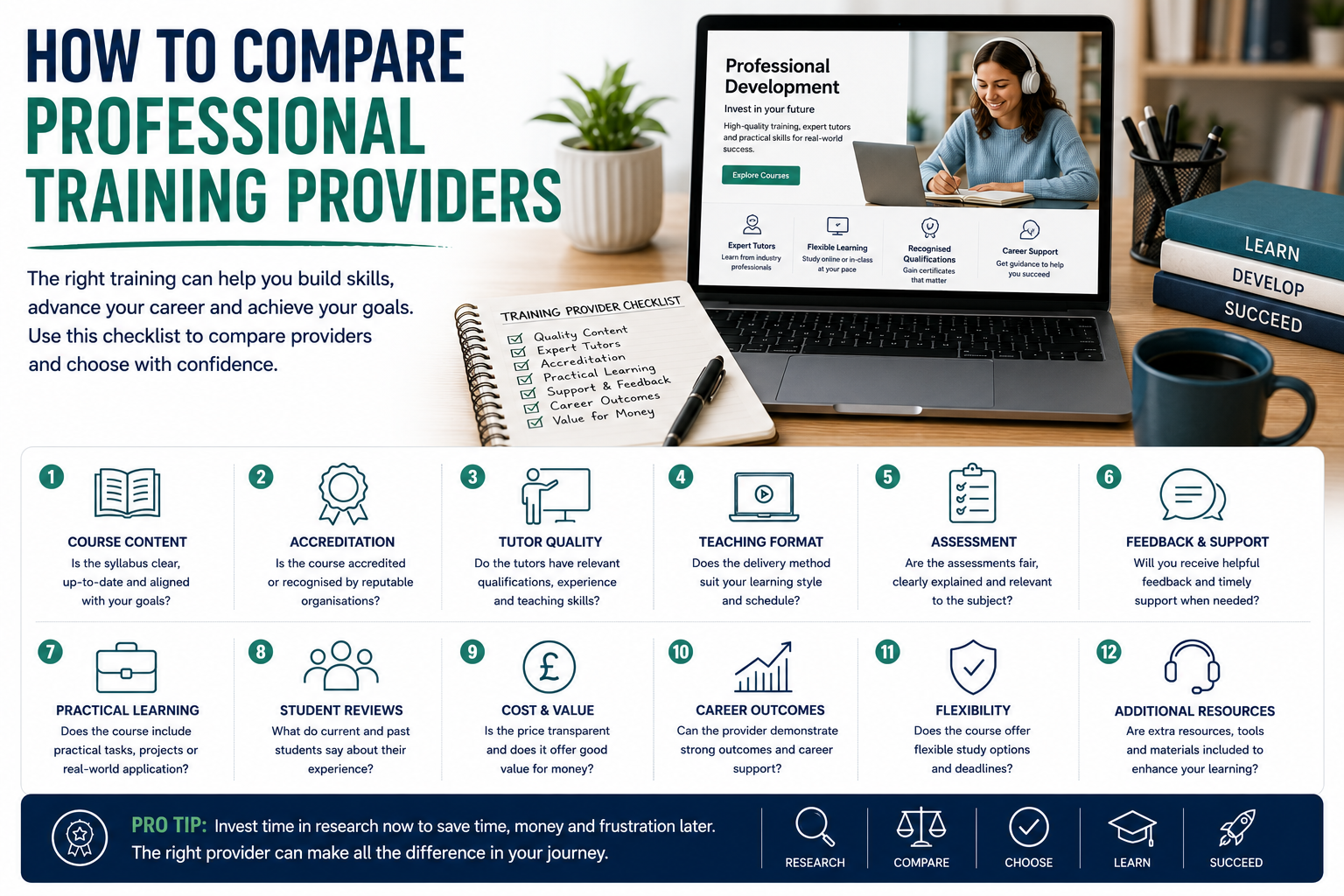
How to Compare Professional Training Providers
Professional training can help people build new skills, meet workplace requirements, prepare for career progression or move into a different industry.
However, training providers vary widely in quality, teaching methods, recognition, support and cost. Two courses with similar titles may offer very different levels of depth and practical value.
A polished website, recognised logo or limited-time discount does not automatically mean that a provider is the right choice.
Before enrolling, learners and employers should compare providers carefully and verify important claims independently.
Start With the Outcome You Need
Before comparing courses, define what the training needs to achieve.
The goal may be to:
- Learn a practical skill
- Gain a recognised qualification
- Meet a workplace requirement
- Prepare for an examination
- Develop management skills
- Change careers
- Improve employability
- Support continuing professional development
- Build a portfolio
- Refresh outdated knowledge
The intended outcome affects which type of provider is most suitable.
Someone exploring a subject may benefit from a short introductory course. A person entering a regulated profession may need a formally recognised programme with supervised assessment.
Without a clear goal, it is easy to choose a course that sounds interesting but does not provide the required result.
Check What the Course Actually Covers
Course titles can be broad or promotional.
A programme called “Complete Digital Marketing Training” might provide a brief introduction to several subjects, while another course with a similar title may include practical assignments, analytics, advertising, content strategy and campaign planning.
Review:
- Course syllabus
- Module descriptions
- Learning outcomes
- Practical exercises
- Assessment methods
- Required reading
- Final project
- Expected skill level
A useful course page should make it clear what learners should be able to do after completing the programme.
Be cautious when descriptions rely mainly on phrases such as:
- Become an expert
- Transform your career
- Master everything
- Get job-ready quickly
- Unlock unlimited earning potential
These claims provide little information about the actual teaching.
Verify Accreditation and Recognition
Training providers often use words such as:
- Accredited
- Certified
- Approved
- Recognised
- Endorsed
These terms do not always mean the same thing.
Ask:
- Which organisation provides the accreditation?
- Does it apply to the full course?
- Is the accrediting body recognised?
- Is the qualification accepted by employers?
- Is it suitable for further study?
- Is it valid in the learner’s country?
- Does it expire?
- Are renewal requirements involved?
For regulated careers, confirm requirements directly with the appropriate professional body, regulator or government source.
A certificate of completion is not necessarily the same as a professional qualification.
Research the Training Provider
Before paying, check the organisation behind the course.
Look for:
- Legal business name
- Physical address
- Contact details
- Named staff
- Company information
- Complaints procedure
- Terms and conditions
- Privacy policy
- Refund policy
- Teaching history
A legitimate provider should make it reasonably easy to understand who operates the organisation.
Warning signs may include:
- No named tutors
- No clear address
- Only a contact form
- Aggressive countdown timers
- Constant “final chance” discounts
- Vague accreditation claims
- Guaranteed employment
- Guaranteed earnings
Several concerns should encourage further investigation.
Review the Tutors
The tutor can strongly influence the quality of the course.
Look for information about:
- Qualifications
- Professional experience
- Teaching experience
- Current industry work
- Specialist knowledge
- Published work
- Professional registration
- Previous students
A tutor may be highly experienced in the subject but have limited teaching ability.
Similarly, a confident presenter may not have substantial professional expertise.
Ideally, the provider should offer both credible subject knowledge and an organised teaching approach.
Where several tutors are involved, check who teaches each part of the programme.
Consider Whether the Material Is Current
Some subjects remain relatively stable, while others change quickly.
Courses involving the following areas may require frequent updates:
- Software
- Technology
- Marketing
- Employment law
- Finance
- Regulation
- Health and safety
- Cybersecurity
- Social media
- Artificial intelligence
Check:
- When the course was created
- When it was last updated
- Whether software screenshots are current
- Whether legislation is up to date
- Whether links still work
- Whether new developments are included
An old course is not automatically poor, but outdated information can reduce its usefulness or create risk.
Compare the Teaching Format
Training may be delivered through:
- In-person classes
- Live online sessions
- Recorded video
- Written lessons
- Workshops
- Practical placements
- One-to-one tuition
- Blended learning
- Self-paced study
Each format has advantages.
In-person learning
This may provide direct interaction, practical facilities and easier access to immediate support.
It may also involve travel, fixed times and higher costs.
Live online learning
This offers real-time teaching without travel.
Check whether sessions are recorded and whether attendance is compulsory.
Self-paced learning
This provides flexibility but requires greater motivation and organisation.
Tutor access may be more limited.
Choose a format that fits the learner’s schedule, learning style and practical needs.
Check the Expected Time Commitment
A course may be advertised as lasting eight weeks without explaining the amount of work required between sessions.
Ask about:
- Teaching hours
- Independent study
- Reading
- Assignments
- Practice
- Group work
- Placement hours
- Exam preparation
A course containing twelve hours of video may require considerably more time when exercises and projects are included.
The schedule should be realistic alongside:
- Employment
- Family responsibilities
- Travel
- Health
- Other study
- Existing commitments
Enrolling in a course that cannot be completed properly is unlikely to provide good value.
Understand the Entry Requirements
Some providers describe courses as beginner-friendly while assuming prior knowledge.
Check whether learners need:
- Previous qualifications
- Work experience
- Software knowledge
- Technical equipment
- Language ability
- Background checks
- Physical ability
- Professional registration
The provider should explain the expected starting level clearly.
A course that is too basic may waste time, while one that is too advanced may become difficult to complete.
Review the Assessment Process
Assessment helps show whether the learner has understood and applied the material.
Methods may include:
- Written assignments
- Practical demonstrations
- Exams
- Portfolios
- Presentations
- Projects
- Workplace observation
- Online quizzes
Ask:
- How many assessments are required?
- Who marks them?
- Is feedback provided?
- What is the pass mark?
- Are resubmissions allowed?
- Are exams supervised?
- Are resit fees charged?
- How long does marking take?
The assessment method should reflect the skill being taught.
A practical course should normally involve meaningful practical assessment rather than only automated quizzes.
Look for Practical Application
A strong course should help learners apply knowledge.
Practical elements may include:
- Realistic projects
- Case studies
- Simulations
- Workshops
- Supervised practice
- Portfolio work
- Workplace assignments
- Feedback sessions
For example, someone studying website design should ideally create and review actual pages.
A learner studying project management may benefit from planning a realistic project rather than only memorising terminology.
Practical work can also provide evidence for future employers.
Check the Quality of Feedback
Feedback helps learners identify strengths, mistakes and areas for improvement.
It may be provided by:
- Tutors
- Assessors
- Industry professionals
- Peer reviewers
- Automated systems
Automated feedback may be suitable for simple tests, but it is less useful for complex writing, creative work or practical performance.
Ask:
- How detailed is the feedback?
- How quickly is it provided?
- Can learners ask follow-up questions?
- Is one-to-one support available?
- Are assignments reviewed by qualified people?
Feedback should help the learner improve rather than only provide a score.
Review Student Support
Support can make a substantial difference, particularly during longer or online programmes.
It may include:
- Tutor contact
- Technical assistance
- Study guidance
- Careers support
- Accessibility support
- Mentoring
- Discussion groups
- Learning resources
- Wellbeing support
Check:
- How support is requested
- Expected response times
- Whether support is included
- Whether help is available outside class
- Who answers subject questions
A provider with a large course catalogue may offer limited personalised support.
Consider Class Size
Class size can influence the learning experience.
A larger group may provide:
- More discussion
- Wider perspectives
- Networking
- Lower prices
A smaller group may offer:
- More tutor attention
- More feedback
- Greater opportunity to ask questions
- Better practical supervision
Ask how many learners typically attend and whether numbers are limited.
For practical or sensitive training, class size may be particularly important.
Review Accessibility
Training should be accessible to as many learners as possible.
Useful provisions may include:
- Captions
- Transcripts
- Step-free access
- Accessible toilets
- Screen-reader compatibility
- Flexible deadlines
- Alternative materials
- Recorded sessions
- Additional learning support
Learners with specific needs should contact the provider before enrolling.
Ask what adjustments can realistically be made.
Understand the Full Cost
The advertised course fee may not include everything.
Additional costs may involve:
- Registration
- Exams
- Certification
- Textbooks
- Software
- Materials
- Equipment
- Travel
- Accommodation
- Membership
- Resits
- Placement checks
Ask for the complete expected cost in writing.
Also review:
- Deposit
- Instalments
- Interest
- Funding
- Employer sponsorship
- Refund terms
- Cancellation fees
A lower headline price may become more expensive once required extras are added.
Compare Payment Plans Carefully
Payment plans can make training more accessible, but the terms should be clear.
Check:
- Total amount payable
- Deposit
- Number of payments
- Interest or finance charges
- Missed-payment consequences
- Whether access stops after a missed payment
- Whether the balance remains due after withdrawal
Do not assume that stopping attendance automatically cancels payment obligations.
Read the contract before enrolling.
Examine Refund and Cancellation Terms
The provider should explain what happens if the learner changes their mind or cannot continue.
Check:
- Cooling-off period
- Refund deadline
- Administration charges
- Transfer options
- Deferral
- Course cancellation
- Digital-access restrictions
- Exceptional circumstances
Some providers may reduce or refuse refunds once course materials have been accessed.
Keep copies of:
- Course description
- Terms
- Payment confirmation
- Accreditation claims
- Emails
These may be important if a dispute arises.
Check Certification Details
A course certificate may confirm:
- Attendance
- Completion
- Assessment
- Continuing professional development
- A regulated qualification
Ask:
- Who issues it?
- Is assessment required?
- Is it included in the fee?
- Is a digital certificate provided?
- Can it be verified?
- Does it expire?
- Is renewal required?
A certificate should not be presented as more significant than it is.
Review Career Support
Some providers offer:
- CV guidance
- Interview preparation
- Portfolio reviews
- Employer introductions
- Job boards
- Work placements
- Networking
- Alumni groups
These services can be useful, but learners should understand what is actually included.
“Career support” may mean access to general articles rather than individual guidance.
Ask for practical details.
Be Cautious With Employment Claims
Claims such as the following should be examined carefully:
- Guaranteed job
- Guaranteed interview
- Guaranteed salary
- Career change in weeks
- Employers actively waiting
- Immediate freelance income
Ask whether the provider publishes:
- Completion rates
- Employment outcomes
- Salary methodology
- Employer partnerships
- Independent verification
- Relevant time periods
Completing training does not automatically guarantee work.
Employment also depends on experience, location, demand, competition and interview performance.
Read Independent Reviews
Reviews may provide insight into:
- Teaching quality
- Course organisation
- Support
- Assessment
- Refunds
- Technical problems
- Certification
- Career relevance
Look for detailed patterns rather than relying on one review.
Be cautious with:
- Reviews containing no detail
- Repeated promotional wording
- Affiliate reviews
- Testimonials only on the provider’s website
- Ratings that refer to a different course
A provider may offer excellent programmes in one area and weaker ones elsewhere, so course-specific feedback is particularly useful.
Ask for a Sample Lesson
A sample lesson can reveal:
- Teaching style
- Production quality
- Course level
- Lesson structure
- Clarity
- Practical depth
- Accessibility
A promotional video may not reflect the normal teaching.
Where possible, ask to see:
- Syllabus
- Sample materials
- Example assignment
- Learning platform
- Tutor demonstration
- Student project
This can help learners make a more informed decision.
Compare Several Providers
Create a simple comparison table.
| Factor | Provider A | Provider B | Provider C |
|---|---|---|---|
| Course content | |||
| Recognition | |||
| Tutor experience | |||
| Delivery format | |||
| Practical work | |||
| Assessment | |||
| Feedback | |||
| Support | |||
| Total cost | |||
| Refund terms | |||
| Career relevance | |||
| Overall confidence |
Comparing several factors helps prevent the decision being based only on price or branding.
Questions to Ask Before Enrolling
Useful questions include:
- What will I be able to do after completing the course?
- Is the qualification formally recognised?
- Who teaches the programme?
- When was the material last updated?
- How much study time is required?
- How will I be assessed?
- Will I receive individual feedback?
- What support is available?
- What is the full cost?
- What happens if I need to withdraw?
- Can I see a sample lesson?
- What evidence supports the career claims?
A credible provider should be willing to answer reasonable questions clearly.
Warning Signs
Potential warning signs include:
- Guaranteed employment
- Guaranteed earnings
- Unclear accreditation
- No named tutors
- No syllabus
- Pressure to enrol immediately
- Hidden costs
- Permanent discounts
- No refund information
- Unrealistic completion times
- Copied course descriptions
- Poorly explained certificates
Several warning signs should encourage learners to consider alternatives.
Final Thoughts
Comparing professional training providers requires more than looking at the course title or headline price.
Course content, recognition, tutor experience, teaching format, assessment, feedback, support and total cost should all be reviewed.
The strongest provider is usually the one that explains clearly what the learner will study, how progress will be assessed and what the course can realistically help them achieve.
Take time to verify important claims, review independent feedback and compare several options before paying.
The right training should provide relevant skills, credible teaching and practical value rather than relying on promotional promises.